
Short answer: AEO (answer engine optimization) means writing and structuring pages so that search engines and AI tools can find a clear answer on them. On my own site, hridoyahmed.com, I mapped what was missing in my AI search content, read Google’s official guidance, and built a connected cluster of one pillar guide and eight supporting guides around my AI search optimization service. This case study shows the steps. It does not claim rankings or AI citations, because no one can guarantee them.
What is AEO, and why does it matter?
People now get answers from Google AI Overviews, AI Mode, ChatGPT and similar tools, often without clicking a link. AEO is the work of making your pages easy to understand and use: a direct answer near the top, clear headings, honest sources and a clear author. It builds on normal SEO. Google’s own guide says that optimizing for generative AI search is still SEO.
I offer this as a service, so my own site should show the method. See my AI search optimization service.
The starting point
Before this project, my AI search section had six guides and one free tool:
- What Is GEO and How Is It Different From SEO?
- Answer Engine Optimization (AEO)
- How to Structure Content So AI Assistants Can Cite It
- Schema Markup for AI Search: What Actually Helps
- What Is llms.txt? Do You Need One?
- Is Your Page Ready for AI Search? A Simple Checklist
- The free AI Search Readiness Checker
These were useful, but they sat side by side with no pillar page to tie them together, and several important questions had no page at all.
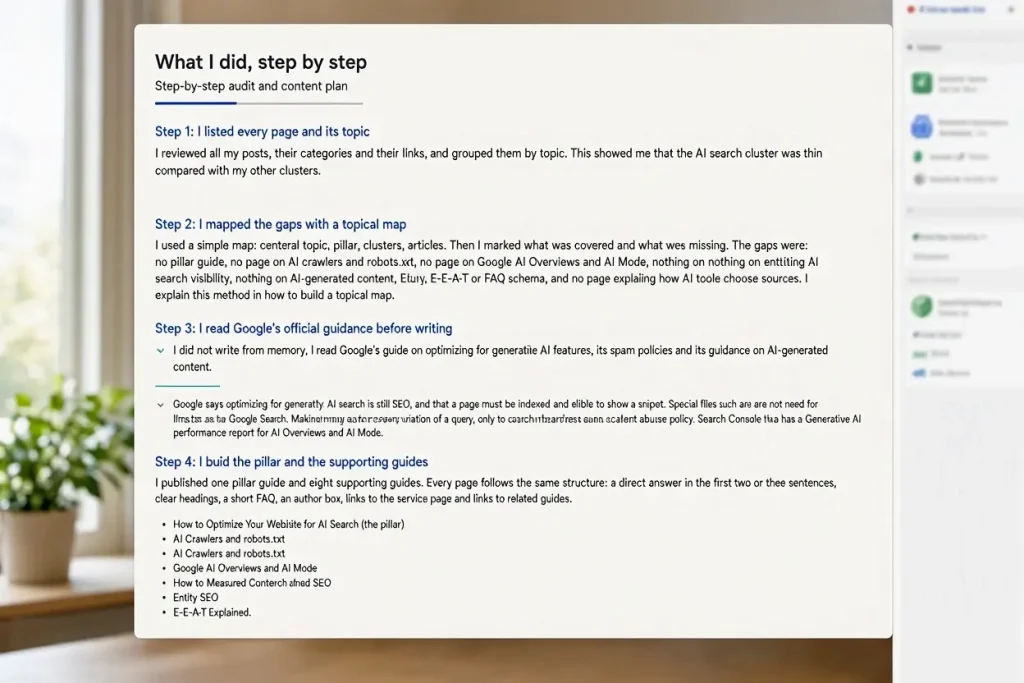
What I did, step by step
Step 1: I listed every page and its topic
I reviewed all my posts, their categories and their links, and grouped them by topic. This showed me that the AI search cluster was thin compared with my other clusters.
Step 2: I mapped the gaps with a topical map
I used a simple map: central topic, pillar, clusters, articles. Then I marked what was covered and what was missing. The gaps were: no pillar guide, no page on AI crawlers and robots.txt, no page on Google AI Overviews and AI Mode, nothing on entities, nothing on measuring AI search visibility, nothing on AI-generated content, E-E-A-T or FAQ schema, and no page explaining how AI tools choose sources. I explain this method in how to build a topical map.
Step 3: I read Google’s official guidance before writing
I did not write from memory. I read Google’s guide on optimizing for generative AI features, its spam policies and its guidance on AI-generated content. The main points I took from them:
- Google says optimizing for generative AI search is still SEO, and that a page must be indexed and eligible to show a snippet.
- Special files such as llms.txt are not needed for Google Search.
- Making many pages for every variation of a query, only to catch searches, can break the scaled content abuse policy.
- Search Console has a Generative AI performance report for AI Overviews and AI Mode.
Step 4: I built the pillar and the supporting guides
I published one pillar guide and eight supporting guides. Every page follows the same structure: a direct answer in the first two or three sentences, clear headings, a short FAQ, an author box, links to the service page and links to related guides.
- How to Optimize Your Website for AI Search (the pillar)
- AI Crawlers and robots.txt
- Google AI Overviews and AI Mode
- How to Measure AI Search Visibility
- Entity SEO
- AI-Generated Content and SEO
- E-E-A-T Explained
- Does FAQ Schema Still Help in 2026?
- How AI Search Tools Choose Sources
Step 5: I linked everything together
The pillar links to the supporting guides, and each supporting guide links back to the pillar and to my AI search service page. I also added the pillar and one new guide to the related guides of the six older posts, so that no page was left on its own. See internal linking for topic clusters.
Step 6: I separated what is known from what is a guess
This field has many claims that nobody has proven. In each guide I marked what the official documentation says and what is unproven, for example llms.txt, special markup for AI tools and how AI tools rank their sources. I did not promise citations anywhere.
Step 7: I set up honest measurement
I use three signals: the Generative AI performance report in Search Console, referral sources in analytics, and monthly spot checks with real customer questions. None of them is a perfect score. I explain the method in how to measure AI search visibility.
What I got wrong and fixed
- My first pillar draft used older Google wording. It said that Google requires no special optimization. After I read Google’s newer guide, I rewrote that section, added the list of things Google says you can ignore, and added the Search Console report.
- FAQ schema. I planned a standard FAQ schema guide. Then I checked Google’s documentation and found that FAQ rich results stopped appearing on May 7, 2026. I wrote the guide around that fact.
- Overlap. Two older posts were close in topic. I gave each one a clear job: one explains AEO, the other covers page structure.
The result so far
This is what I can state as fact:
- The AI search cluster now has one pillar guide and eight supporting guides, all live.
- The six older guides now link to the pillar and to a new guide.
- Every guide has a direct answer at the top, a FAQ, an author box and links to my AI search service.
- The measurement setup described above is in place for me to review each month.
I am not claiming any ranking, traffic or AI citation result in this case study. It covers the build, and it is too soon to report outcomes honestly.
How you can do the same on your site
- List your pages and group them by topic.
- Map the gaps: pillar, clusters, supporting pages.
- Read the official guidance from Google and from other AI tools before you write.
- Write the answer first, and add your own experience.
- Link the pages together with clear anchor text.
- Mark what is known and what is unproven.
- Measure with a few honest signals and review them monthly.
If you would like an expert to do this for your site, see my AI search optimization service.
What I learned
- Read the official source first. Google’s guidance changed during the year, and an older source would have given me a wrong claim.
- A pillar page makes a group of posts easier to understand for readers and machines.
- Honest “I do not know” statements build more trust than promises.
- Do not publish many thin pages to fill a map. A few useful pages are better.
Frequently asked questions
What is AEO?
AEO is answer engine optimization. It means writing clear, direct answers and structuring pages so that search engines and AI tools can understand and use them.
Is AEO different from SEO?
For Google, Google says optimizing for generative AI search is still SEO. For other AI tools, the work is similar, but how they choose sources is not public.
Can you guarantee that ChatGPT or Google will cite my site?
No. No one can. I will tell you honestly what helps and what is a guess.
How long does an AEO project take?
It depends on the size of your site and your existing content. This project took a few days of work, and measuring results takes longer.
Can you do this for my website?
Yes. Send me a message and I will review your site first and tell you what to fix first.
Need help with AI search?
If you would like a clear plan for your site, see my AI search optimization service or contact me for a free audit.
Related guides
- How to Optimize Your Website for AI Search: A Practical Guide
- How to Measure AI Search Visibility and AI Referral Traffic
- AI Crawlers and robots.txt: How to Allow or Block GPTBot, ClaudeBot and More
Written by Hridoy Ahmed, SEO specialist and WordPress security expert, with 8+ years of experience.