
By Hridoy Ahmed | Last updated: October 2026 | 9 min read
Short answer: Topical authority is an SEO idea that a site which covers a topic completely, clearly and in a connected way becomes a stronger source on that topic. It is a community term, not a score that Google publishes. You build it by choosing a focused topic, mapping what people need to know, publishing useful pages with real experience, and linking them together. No one can guarantee rankings from it.
In this guide
- What topical authority means
- What Google says
- What strong coverage looks like
- 7 steps to build it
- How to check your progress
- FAQ
What topical authority means
The idea comes from the semantic SEO community. A site that answers most of the important questions about one subject, in depth and with clear links between its pages, is treated as a more complete source than a site with a few scattered posts. One often quoted definition describes it as how much of a topic you cover, and for how long.
It is a planning model. It helps you decide what to publish and how to connect it. My semantic SEO guide explains the wider method, including entities and topical maps.
What Google says
Google does not publish a “topical authority” score. Its guidance talks about creating helpful, reliable, people-first content. In its guide to AI features, Google also says that unique, non-commodity content with first-hand knowledge is likely to matter most over time.
So treat topical authority as a way to organize good content. It is not a guarantee, and it does not replace quality. A hundred thin pages on one topic do not build authority. They can even break Google’s scaled content abuse policy. See my guide to AI-generated content and SEO.
What strong coverage looks like
- Focus: the site is clearly about one main subject, not everything.
- Completeness: the main questions, problems and decisions in that subject have their own useful pages.
- Depth: each page answers its question well, with real examples and experience.
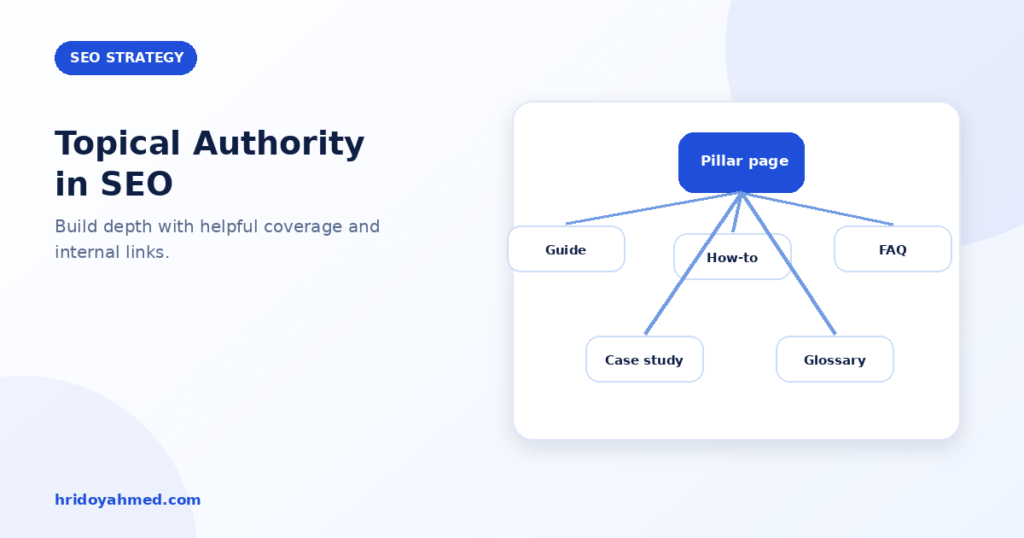
- Connections: pages link to each other in a clear structure, from a pillar page down to specific guides.
- Freshness: old pages are checked and updated.
- Trust: there is a clear author and a clear About page. See my guide to E-E-A-T.
7 steps to build it
Step 1: Choose one focused topic
Write one sentence: “This site is about [topic], for [audience], from the angle of [my experience].” A narrow, honest topic is easier to cover than a broad one.
Step 2: List what people need to know
List the questions, problems, comparisons and decisions in the topic. Use Search Console queries, real customer questions and the search results themselves.
Step 3: Build a topical map
Group the list into a pillar page, cluster pages and supporting pages. Give each page one intent and one primary keyword. I show the steps in how to build a topical map.
Step 4: Publish the core pages first
Start with the pages closest to what you sell or do. Then add supporting guides. Do not publish dozens of weak pages just to fill a map.
Step 5: Add real experience to every page
Use your own examples, screenshots and mistakes you have seen. This is what makes content non-commodity.
Step 6: Link the pages with clear anchors
Link each guide to its pillar or service page, and to one or two close siblings. See internal linking for topic clusters. If you want help with the plan, see my SEO and technical SEO service.
Step 7: Review and improve every few months
Merge pages that overlap, update old facts and fill the gaps you find. See how to do a content gap analysis.
How to check your progress
- Indexing: are your new pages indexed? Check the Pages report in Search Console.
- Group performance: in the Performance report, filter by a folder or a group of queries on one topic, and watch impressions and clicks together.
- Coverage sheet: keep a list of the questions in your topic and mark which ones now have a good page.
- Leads: watch clicks from guides to your service page and enquiries.
Be patient. No one can give a fixed time, because it depends on your site, your niche and how consistently you publish.
Common mistakes
- Choosing a topic that is too broad
- Publishing many thin pages instead of a few useful ones
- Two pages answering the same question for the same intent
- Leaving pages unlinked, so the structure is unclear
- Copying competitors’ headings and adding nothing new
- Treating “topical authority” as a guaranteed result
FAQ
Is topical authority a Google ranking factor?
Google does not list it as one. It is an SEO model for planning coverage and quality.
How many posts do I need?
There is no set number. A small service business may need a pillar page and 10 to 30 useful supporting pages. Quality and clear intent matter more than count.
How long does it take?
No one can say reliably. It depends on your site’s age, niche, content quality and publishing pace.
Can I build topical authority on a new site?
You can build a clear, focused structure from the start. Results depend on many factors, and no one can promise outcomes.
Want a clear topic plan for your site? I map your topics, find the gaps and fix the structure. See my SEO and technical SEO service.
About the author: Hridoy Ahmed is an SEO specialist and WordPress security expert based in Dhaka, Bangladesh. He has 8+ years of experience and works with clients worldwide.
Related guides
- Semantic SEO: A Practical Guide to Entities, Topical Maps and Topical Authority
- How to Build a Topical Map: A Step-by-Step Guide
- SEO Clusters: The Complete Guide to Building a Smarter SEO Strategy
Related reading: to turn this idea into a plan, see how to build a topical map. To group your keywords and pages, read the SEO clusters guide.