
By Hridoy Ahmed | Last updated: October 2026 | 8 min read
Short answer: A content gap analysis finds the topics, questions and page types your site is missing, or covers badly, compared with what your audience needs. To do one, list the pages you have, list what people need to know, check the real search results, find missing and weak pages, and rank the gaps by business value. A tool can help, but the decisions are yours.
In this guide
- What a content gap is
- 7 steps to run an analysis
- Types of gaps
- Free tools to use
- Common mistakes
- FAQ
What a content gap is
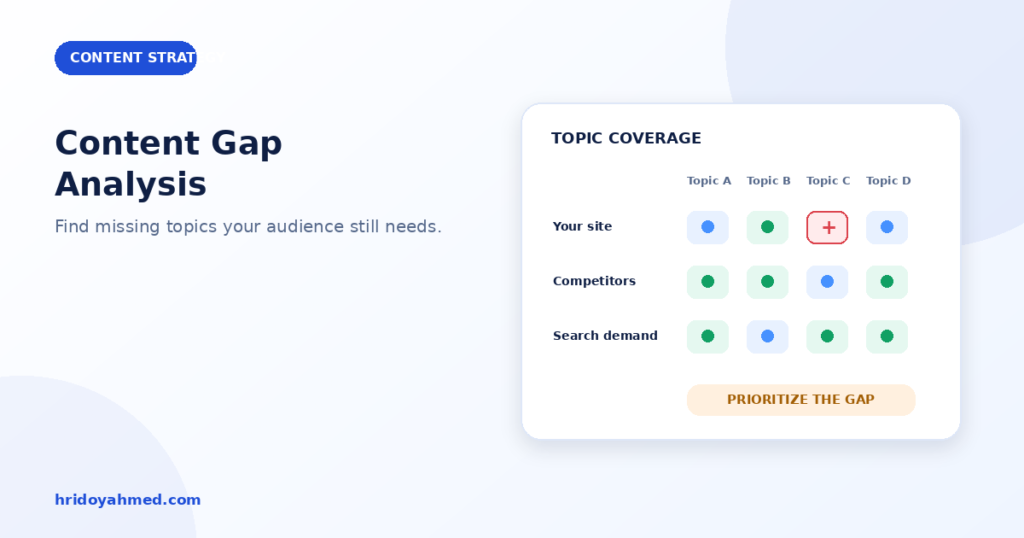
A content gap is something your audience needs that your site does not give them, or does not give well enough. It might be a missing guide, a question with no answer, a page that is thin or out of date, or a page of the wrong type for the search.
The aim is not to copy every topic a competitor covers. It is to find the gaps that matter for your readers and for your business.
7 steps to run an analysis
Step 1: List what you already have
Export or write down all your pages and posts with their main topic and intent. A simple sheet works. If you have a topical map, use it.
Step 2: List what people need to know
Write the questions, problems, comparisons and decisions in your topic. Use customer emails, sales calls, “People also ask” and the questions you answer most often.
Step 3: Check Search Console
In the Performance report, look at queries that show many impressions but few clicks, or an average position far down the page. These show topics where Google already sees your site as somewhat relevant, but your page may not answer the question well. Also look for queries that have no good page on your site at all.
Step 4: Check the real search results
Search each important query. See which kinds of pages rank, what subtopics they all cover, and what questions they answer. This checks intent. See search intent in SEO.
Step 5: Mark each gap
For each topic, write one of these: no page, weak page, wrong page type, out of date, or covered well. Also mark overlaps where two pages answer the same question. See keyword cannibalization.
Step 6: Rank the gaps by value
Score each gap by how close it is to your offer, how many readers it helps, and how hard it is to do well. Fill the gaps closest to your service pages first.
Step 7: Plan and write with a brief
Turn the top gaps into pages or updates. Write a brief for each. See how to plan an SEO content brief. Then add your own experience, so you do not just repeat what exists. If you want help, see my SEO and technical SEO service.
Types of gaps
- Missing topic: a question your audience asks, with no page on your site.
- Thin coverage: a page exists but skips key points that top results cover.
- Intent mismatch: the page is a blog post, but searchers want a service page, or the reverse.
- Outdated content: facts, screenshots or advice that changed.
- Missing experience: a generic page with no examples or proof.
- Weak links: a good page that nothing links to.
Free tools to use
- Google Search Console for your queries, pages and indexing.
- Google search results for intent and “People also ask”.
- A spreadsheet for your gap list.
- Ahrefs Free for audits and backlink data on a site you own and verify. See my guide to underrated SEO tools.
Paid tools can compare your keywords with competitors’ keywords faster. Use them as a source of ideas, and check each idea against the real results and your own audience.
Common mistakes
- Copying competitor topics that do not fit your business
- Filling gaps with thin AI pages. See AI-generated content and SEO
- Ignoring the gaps inside your own old pages
- Choosing gaps by search volume alone
- Not recording the analysis date and what you changed
FAQ
How often should I run a content gap analysis?
Every three to six months is enough for most sites.
Do I need a competitor tool?
No. Search Console, the search results and a spreadsheet are enough to start.
Should I fill every gap?
No. Fill the ones that help your readers and your business first.
Is updating an old page better than writing a new one?
Often yes, when the topic is already covered. Update it so you do not create two pages for one intent.
Want to know what your site is missing? I review your pages and rank the gaps by value. See my SEO and technical SEO service.
About the author: Hridoy Ahmed is an SEO specialist and WordPress security expert based in Dhaka, Bangladesh. He has 8+ years of experience and works with clients worldwide.