
By Hridoy Ahmed | Last updated: October 25, 2026 | 8 min read
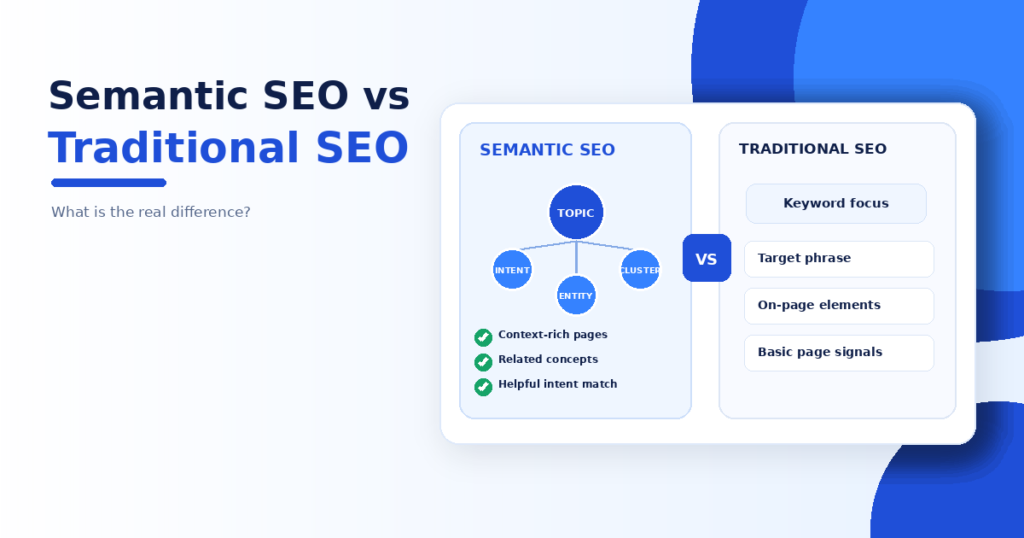
Short answer: Traditional SEO usually starts with a keyword and builds one page around it. Semantic SEO starts with a topic and builds a connected set of pages around what people need to know. Semantic SEO is not a replacement. It is a more complete way to plan content, and it still uses keyword research.
If you read my full semantic SEO guide, you have seen the idea. This post goes deeper on one question: how is it actually different from the way most people do SEO, and which one should you use?
The difference in one table
| Area | Traditional (keyword-first) SEO | Semantic SEO |
|---|---|---|
| Starting point | A keyword list | A topic (entity) and its attributes |
| One page is built for | One main phrase | One search intent inside a bigger topic |
| Planning | Page by page | A map of connected pages |
| Internal links | Often added later | Planned from the start |
| Coverage | Topics with search volume | Also needed subtopics with little volume |
| Success measure | Rank for a phrase | Indexing, topic-level impressions, conversions |
A real-life comparison
Imagine a site that sells honey. This is an illustration, not a client result.
- Keyword-first approach: Make one page for “buy raw honey”, one for “organic honey” and one for “honey online”. The pages repeat each other with small changes.
- Semantic approach: Treat “honey” as the main topic. Plan a category page for buying, guides on how to tell if honey is pure, how to store it, how long it lasts and how different types differ. Each page has its own intent, and they link to each other and to the shop.
The first site risks pages that compete with each other. The second gives each page a clear job.
When traditional SEO is enough
- You have a very small site with a few pages.
- You are fixing basic problems such as titles, speed or indexing.
- You sell something where a few pages cover everything people ask.
When semantic SEO helps more
- You want to cover a whole subject, not one phrase.
- You publish many pages and they start to overlap.
- Your content is correct but thin compared with the pages that rank.
- You want your site to be easy for both search engines and AI tools to understand.
Do you have to choose?
No. Good SEO uses both. You still do keyword research to see demand and the words people use. You still fix technical problems. Semantic SEO changes how you group keywords and decide which pages should exist. If you already have keyword lists, my guide to clustering keywords is the best next step.
Common myths
- “Semantic SEO means no keywords.” Wrong. You still need them.
- “It is a Google ranking factor.” Google does not list it as one. It is a working method.
- “It means adding LSI keywords.” That is a myth too. Read LSI keywords: do they exist?
- “More pages always means better.” No. Thin pages hurt more than they help.
FAQ
Is semantic SEO better than traditional SEO?
It is not a competition. Semantic SEO is a way of planning content inside SEO. It works best when your technical basics and keyword research are already in place.
Does semantic SEO replace keyword research?
No. Keyword research shows demand. Semantic SEO helps you organize it and add the topics that have little volume.
Will semantic SEO improve my rankings?
It can help your content cover a topic better, but no one can guarantee rankings.
Not sure which approach your site needs? I review your pages and tell you honestly what to fix first. See my SEO and technical SEO services.
Related reading: What Is Semantic SEO?, topical authority in SEO and how to build a topical map.
About the author: Hridoy Ahmed is an SEO specialist and WordPress security expert based in Dhaka, Bangladesh, with 8+ years of experience.