
By Hridoy Ahmed | Last updated: October 25, 2026 | 9 min read
Short answer: Yes, you can automate part of semantic SEO. Software and AI are good at the list work: grouping keywords, drafting topic ideas, outlines, link suggestions and reports. They are not good at checking search intent, verifying facts or adding real experience. Automate the boring steps and keep the decisions human.
Semantic SEO has a lot of list work. You collect questions, group them, build a topical map, write briefs and plan internal links. That is exactly the kind of work people want to automate. This guide shows what is safe to hand over, what is not, and a simple workflow you can follow. For the basics, start with my complete semantic SEO guide.
What you can automate
- Keyword grouping. Turning a list of 500 queries into topic groups. Tools and AI do this fast. You then check each group by hand.
- Topic and question ideas. AI can suggest subtopics and questions around an entity. Treat them as a draft list.
- Briefs and outlines. A first draft of headings, questions to answer and entities to mention.
- Internal link suggestions. A tool can spot pages that mention a topic but do not link to its page.
- Schema drafts. AI can write JSON-LD for you to test. Always validate it and match it to the visible text.
- Reporting. Pulling Search Console data into a weekly or monthly summary.
What you should keep human
- Checking intent. Open the real search results. Are they guides, tools or service pages? AI cannot see your live results unless you give it that data, and it can guess wrong.
- Deciding the map. Which pages to create, merge or delete is a judgment call that depends on your business.
- Fact-checking. AI can state wrong facts with confidence. Google’s guidance says AI-generated content still has to be accurate and useful.
- Your experience. Real examples, screenshots and mistakes are what make a page different from the next one. Software cannot invent your experience honestly.
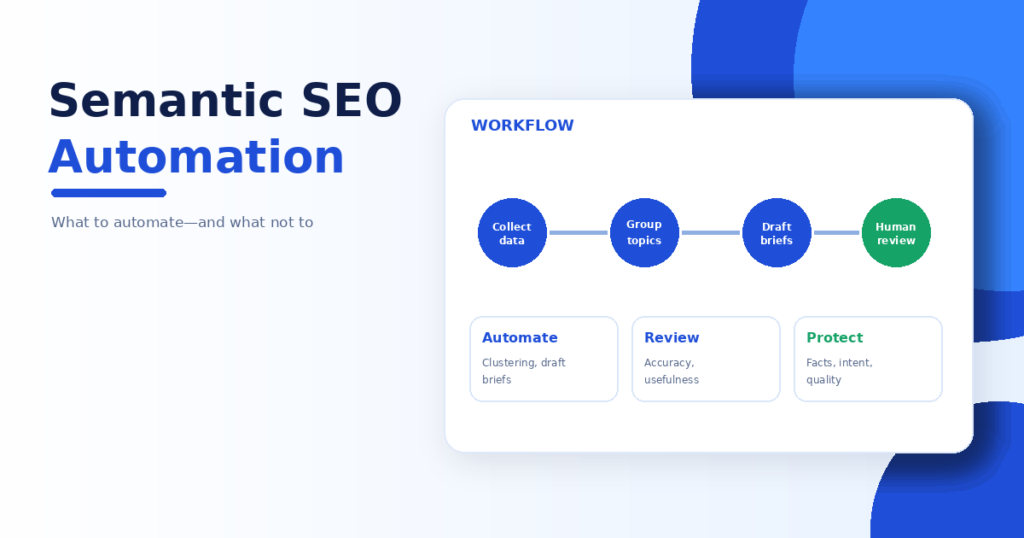
A simple 4-step workflow
1. Prepare the data
Export your Search Console queries, your site’s page list and the “People also ask” questions for your main topic. Write your central entity and audience in one sentence.
2. Let AI draft
Ask for groups, a draft map and briefs. A useful prompt is: “Group these queries by search intent. Do not invent new queries. Mark any group you are unsure about.” Telling the tool not to invent things reduces made-up output, but it does not remove it.
3. Check by hand
For every page in the draft map, search the main query yourself. Note what type of page ranks. Remove overlaps, fix intents and cross out anything that does not fit your real business.
4. Publish and watch
Publish the core pages first. Watch indexing and impressions in Search Console. Update the map every few months.
Can ChatGPT do semantic SEO for you?
It can help with the draft steps above. It cannot do the whole job. It does not know your customers, it may not know current search results and it can be wrong. If you give it your own data, it becomes a much better assistant. Also be careful with private client data: check the tool’s terms before you paste anything sensitive.
What about dedicated tools?
Some tools are built for this method, for example SemanticOS and a few Chrome extensions. I describe them, with the vendors’ own claims clearly marked, in the tools section of my semantic SEO guide. My advice is the same for any tool: test it on a small project, compare its output to the real search results and treat it as a plan, not proof that something will rank.
Common mistakes with automation
- Publishing AI text without fact-checking.
- Creating dozens of thin pages because a tool listed them.
- Trusting a “topical authority score” that Google does not publish.
- Letting two pages answer the same intent.
- Skipping the human check on search intent.
FAQ
Can semantic SEO be fully automated?
No. The list work can be automated, but intent checks, fact-checking and original experience need a person.
What is the best tool for semantic SEO automation?
It depends on your budget and project size. Start with Google Search Console and a spreadsheet, then test any paid tool on one small project.
Will automation get me to page one?
No one can promise that. Automation saves time. Rankings still depend on content quality, competition and your site.
Is AI content bad for SEO?
Google says what matters is whether content is helpful and accurate, not only how it was made. Unchecked, generic AI text is a risk.
Want help planning your topical map? I check intent against real results and build a map you can follow. See my SEO and technical SEO services.
Related reading: how to build a topical map, how to cluster keywords and does ChatGPT use semantic search?
About the author: Hridoy Ahmed is an SEO specialist and WordPress security expert based in Dhaka, Bangladesh, with 8+ years of experience.