
By Hridoy Ahmed | Last updated: October 26, 2026 | 12 min read
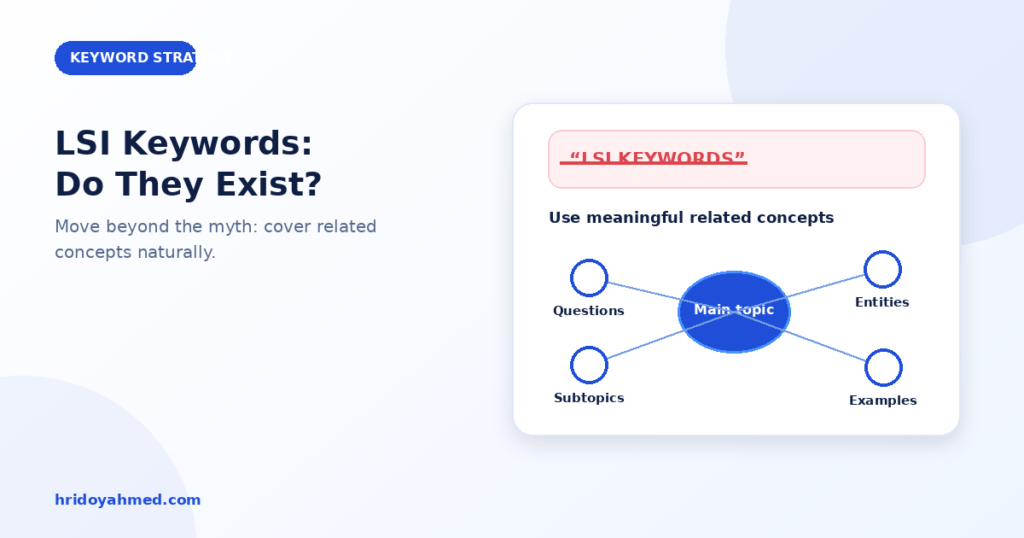
Short answer: LSI keywords are words and phrases that people call “related keywords”, such as “espresso” and “grinder” for “coffee machine”. The name comes from latent semantic indexing (LSI), an old information retrieval method. Google’s John Mueller said in 2019 that there is no such thing as LSI keywords. The useful idea is real: cover the related topics, questions and terms a reader expects, and write them naturally. The “LSI” label is wrong.
In this guide
- LSI keywords meaning
- What John Mueller said
- LSI keywords examples and list
- LSI Graph, generators and checkers
- What to do instead
- LSI, embeddings and AI search
- LSI keywords vs long-tail keywords
- Good SEO keywords and keyword types
- Common mistakes
- FAQ
LSI keywords meaning: what does LSI stand for?
LSI stands for latent semantic indexing. It is an information retrieval technique from the late 1980s, also known as latent semantic analysis (LSA). It was designed to find relationships between words in small, fixed sets of documents. The patent was granted to Bell Communications Research. The web is far bigger and changes all the time, so LSI was never a good fit for a modern search engine.
“LSI keywords” is a name that some SEO tools and articles use for related words, synonyms and suggestions. The name borrows a technical term, but those lists do not come from latent semantic analysis. So when someone asks “what is an LSI keyword in SEO?”, the honest answer is: it is a popular label for related keywords, and not a Google concept.
What John Mueller said about LSI keywords
On July 30, 2019, Google’s John Mueller wrote on social media that “there’s no such thing as LSI keywords” and said that anyone who tells you otherwise is mistaken. Search Engine Roundtable reported it in Google: There Is No Such Thing As LSI Keywords.
What this means in practice:
- Google does not tell you to add “LSI keywords” to rank.
- No Google tool shows you an “LSI keyword” score.
- A paid “LSI keyword tool” is not giving you secret Google data.
Mueller did not say that related words are useless. Pages that cover a topic well do contain related words, because that is how people write about it.
LSI keywords examples and list
An example of an LSI keyword is a term related to your main keyword. These are examples of related keywords, not true LSI keywords. I use them to show how to think about a topic.
| Main keyword | Related terms people expect to see | Questions readers ask |
|---|---|---|
| coffee machine | espresso, grinder, filter, descaling, pods, milk frother | How often should I descale it? Which type is best for beginners? |
| WordPress security | malware, plugin updates, firewall, backup, two-factor authentication, login | How do I know if my site is hacked? How do I clean it? |
| semantic SEO | entities, search intent, topical map, internal links, schema, topical authority | What is a semantic SEO example? Is it a ranking factor? |
| raw honey | origin, filtered, crystallised, storage, shelf life, jar size | How can I tell if honey is pure? How long does it last? |
The list is a thinking tool, not a recipe. You do not need to include every term in the table. Use the ones a real reader needs, in the places where they fit.
LSI Graph, LSI keyword generators, checkers and free tools
People often search for “LSI Graph”, “LSI keywords generator”, “LSI keywords checker” and “LSI keywords free tool”. Here is the plain truth about them.
| What you searched for | What it really is | What to use |
|---|---|---|
| LSI Graph and other “LSI graph tools” | Tools that show related keyword suggestions. As far as I know, they do not run real latent semantic analysis | Use them for ideas only, then check each idea in the search results |
| LSI keywords generator | A related-keyword or synonym generator | Google autocomplete, “People also ask” and “Related searches” |
| LSI keywords checker | There is no real “LSI checker”. Google has no such score | Compare your page with the top results and check topic coverage by hand. See entity coverage in SEO |
| LSI keywords free tool | A free related-keyword tool | Google Search Console, Google Trends, Google Keyword Planner (needs a Google Ads account). Some tools have limited free plans, so check their current limits |
| LSI keywords PDF | Someone’s downloaded list of related words | Make your own list for your topic, using the table above as a template |
For more tool ideas, see my guides to SEO tools for small businesses and SEO audit tools.
How to find related keywords the right way
- Start from the search intent. Know what the reader wants to do. See search intent in SEO.
- Read the top results. Note the subtopics and questions they all cover.
- Use “People also ask” and Google autocomplete for questions real people ask.
- Check Search Console. The queries already linked to your page show words you did not plan for.
- List the entities and attributes a reader expects on the topic. See my semantic SEO guide and semantic keywords guide.
- Write naturally. Use synonyms and related terms where a human would use them. Do not aim for a fixed “density”.
- Add your own experience. Real examples and proof matter more than any word list.
- Check the page against a brief. See how to plan an SEO content brief.
If you want a simple “generator” you can use today, ask yourself or an AI tool: “What subtopics, questions and related terms would an expert cover on [topic]?” Then check every answer against the real search results, because AI tools can be wrong.
Want an expert to review your pages for topic coverage? See my SEO and technical SEO service.
LSI, embeddings and AI search
Modern search and AI tools understand meaning in a different way from LSI. Many systems turn text into numbers called embeddings, so texts with similar meaning sit close together. LSI used a much older math method on a fixed set of documents. The goal feels similar, which is one reason the myth lives on, but they are not the same thing. How Google or ChatGPT pick sources is not fully public, so I keep claims careful. See my notes on semantic search in ChatGPT and NLP SEO.
The practical lesson for AI search is the same: write clear, complete answers that cover the topic. A list of magic words does nothing.
LSI keywords vs long-tail keywords: what is the difference?
They are two different ideas, and many people mix them up. “LSI keywords” is a popular name for related words and topics that belong on a page. Long-tail keywords are specific search phrases that you choose to target. One is about what you put inside the page. The other is about which search you aim at.
| Feature | “LSI” keywords (related keywords) | Long-tail keywords |
|---|---|---|
| What it is | Related words, synonyms and sub-topics for a main topic | A specific, usually longer search phrase |
| Is it a Google concept? | No. “LSI” is a label from SEO tools. Google’s John Mueller said LSI keywords do not exist | It is an SEO term for specific searches. It is not a Google ranking factor |
| Main purpose | Help you cover the topic completely and naturally | Match a specific search intent and a narrow niche |
| Form | Single words or short phrases | Usually 3 or more words |
| Example (main topic: coffee machine) | espresso, grinder, descaling, milk frother | best stainless steel drip coffee maker for home |
| Where you use it | Naturally inside the page text and headings | As the main target of a page, in the title and a heading |
You can use both on the same page. Pick a long-tail phrase as the target, and then cover the related terms a reader expects while you write. For example, a page that targets “best stainless steel drip coffee maker for home” will naturally mention carafes, brew time and cleaning. See my full guide to long-tail keywords for how to find and use them.
Good SEO keywords and the types of keywords
What are good keywords for SEO?
A good keyword passes five checks:
| Check | Ask yourself |
|---|---|
| Relevant | Does it match what my page or business really offers? |
| Intent | Do the top results look like the page I plan to make? |
| Demand | Do people search for it? (A tool or Search Console gives an estimate) |
| Competition | Can my site realistically compete today? See low-competition keywords and SERP analysis to check. |
| Value | Would a visitor from this search help my business? |
How do I create SEO keywords?
Start with a seed idea, expand it with autocomplete, “People also ask” and Search Console, check the search intent, check the competition and give each keyword to one page. My guides to keyword research and clustering keywords show the steps.
What are the four types of keywords for SEO?
By search intent, the four types are informational (learn), navigational (find a site), commercial (compare) and transactional (buy or hire).
What are the 16 types of SEO keywords?
There is no official list of 16. Different sites list 10, 12 or 16 types because they split the same ideas in different ways. The simple groups are by intent, by length (short, mid and long-tail keywords), by role on the page (primary, secondary, related), by audience or place (branded, non-branded, local) and by timing (evergreen or seasonal).
How many keywords per 1000 words?
There is no correct number. Google does not publish a keyword density rule, and old rules like “1 to 2 percent” are not official. Use one main phrase naturally, add related terms where they help and read the page aloud. If a phrase sounds forced, cut it. Google’s spam policies warn against repeating words unnaturally.
What are the 10 best SEO tools?
It depends on your budget and goals. Ten widely used tools are Google Search Console, Bing Webmaster Tools, Google Analytics, Google Keyword Planner, Google Trends, Screaming Frog, Ahrefs, Semrush, Mangools and Rank Math (for WordPress). The first five are free. I am not ranking them.
Common mistakes
- Paying for an “LSI keyword tool”
- Adding a list of related words to the end of a page
- Forcing synonyms into sentences where they sound wrong
- Skipping the search intent check
- Copying the wording of competitors
- Thinking a keyword count per page matters more than the answer
FAQ
What is an LSI keyword?
It is a popular name for a word or phrase related to your main keyword. It is not a Google term, and it does not come from real latent semantic indexing.
Does Google use LSI keywords?
No. John Mueller said in 2019 that there is no such thing as LSI keywords, and there is no evidence that Google uses the old LSI method.
Does using LSI keywords help me rank high?
Not as a trick. Covering a topic well helps readers, and related words appear naturally when you do. Adding words to chase a score does not.
Are related keywords useless?
No. Related terms, questions and entities help you cover a topic completely. The idea is useful. The label “LSI” is wrong.
Should I use a related keyword tool?
You can use one for ideas, but check each idea against real search results and the reader’s intent.
How many related keywords should I add?
There is no number. Add terms where the reader needs them.
Want your content reviewed for real topic coverage? I check intent, structure and gaps and give you a clear fix list. See my SEO and technical SEO service.
About the author: Hridoy Ahmed is an SEO specialist and WordPress security expert based in Dhaka, Bangladesh. He has 8+ years of experience and works with clients worldwide.
Sources
- Search Engine Roundtable, Google: There Is No Such Thing As LSI Keywords (July 31, 2019)
- Ahrefs, LSI Keywords: What are They and Do They Matter?
Related guides
- What Is Semantic SEO? Examples, Steps and Why It Matters (2026)
- Semantic Keywords: How to Find and Use Them (With Examples)
- Search Intent in SEO: How to Match Keywords to the Right Page
- Entity SEO: How to Help Search and AI Understand Your Brand
- How to Do Keyword Research: A Step-by-Step Guide for Beginners
Related reading: for what to use instead of LSI keywords, see semantic keywords: how to find and use them.