
By Hridoy Ahmed | Last updated: October 2026 | 8 min read
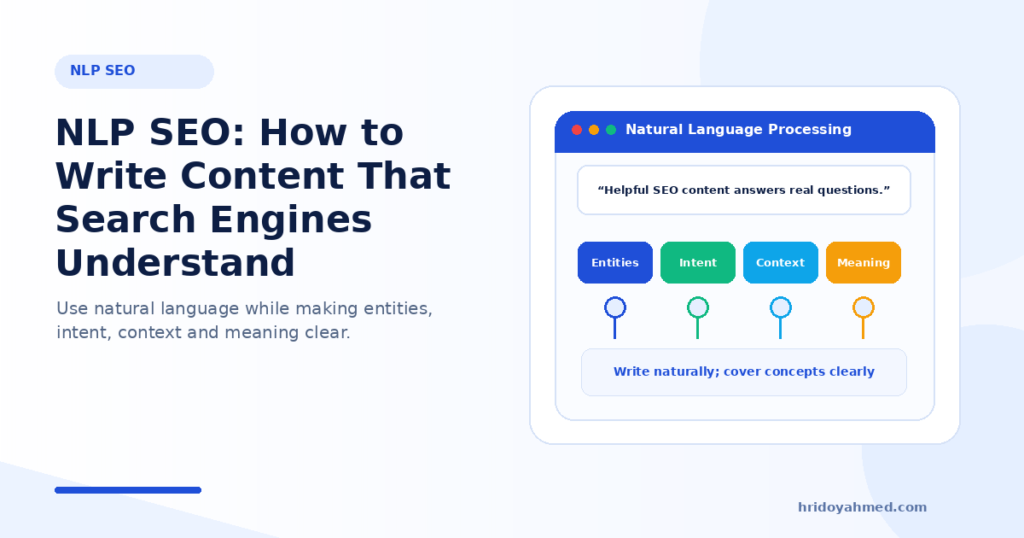
Short answer: NLP (natural language processing) is how computers read and make sense of human language. Search engines use it to understand queries and pages. There is no “NLP score” to optimize, so the practical job is clear writing: name things plainly, answer the question first, cover the related questions and keep each section on one idea.
In this guide
- What NLP means in SEO
- What Google has said
- 7 writing habits that help
- How to check your page
- Myths to skip
- FAQ
What NLP means in SEO
Natural language processing is the part of computer science that teaches machines to work with human language. In search, it helps with jobs like working out what a query means, which words in a page are names of things, and how one sentence relates to the next.
You do not need the maths. You only need one idea: a machine reads your page as text. Clear text is easier to understand than vague text, for machines and for people.
What Google has said
Google has said it uses language models such as BERT to better understand search queries, including small words that change the meaning of a question. Google’s guidance for site owners is still simple: create helpful, people-first content. It does not include an NLP checklist, and it does not ask you to run your text through an NLP tool.
So treat NLP as a reason to write clearly. Do not treat it as a trick. For the wider picture, see my semantic SEO guide.
7 writing habits that help
1. Answer first
Put the direct answer in the first two or three sentences. Then explain. This helps a reader who is in a hurry, and it makes the main point easy to find.
2. Name things plainly and keep the name
Use the full name of a thing the first time, then keep using the same name. Do not switch between three terms for one idea. Avoid “it” and “this” when the noun is far away.
Vague: “It can help with this if you set it up well.”
Clear: “A page cache can lower server load because it serves a saved copy of the page instead of building the page again.”
3. One idea per paragraph, one topic per heading
Short paragraphs with a clear point are easier to read and easier to split into parts. If a paragraph covers two ideas, split it.
4. Write headings that describe the section
A heading like “How to check indexing in Search Console” tells everyone what comes next. A heading like “Let’s dive in” tells no one anything.
5. Cover the related questions
Readers ask follow-up questions. Answer the ones that belong on the page. This is different from adding synonyms to look “semantic”. See my post on LSI keywords and on entity coverage.
6. Use lists and tables for steps and comparisons
When content is a sequence or a comparison, show it as one. Structure makes the relationship between items clear.
7. Be specific
Names, conditions, limits and examples beat general advice. See Entity-Attribute-Value in SEO for a simple way to plan specific facts.
How to check your page
- Read it aloud. If you stumble, a reader will too.
- Test one paragraph. Could a person who knows nothing about the topic understand it?
- Try a language tool for a second view. Google Cloud has a Natural Language API demo where you can paste text and see the names and topics it picks out. It is a separate product. It does not show how Google Search ranks your page, so use it only to spot unclear writing.
If you want an expert to review your key pages, see my SEO and technical SEO service.
Myths to skip
- “NLP keywords” lists. A tool can suggest related terms. They are ideas, not requirements.
- Chasing a score. No official score tells you how well a page is understood by Google.
- Stuffing names and terms. It makes text harder to read and does not help.
- Writing for bots. Write for the reader who has the problem. Clear writing for people is also clear for machines.
FAQ
Is NLP a ranking factor?
NLP is a set of methods search systems use to understand language. It is not a single ranking factor you can switch on, and Google has not published an NLP checklist for sites.
Do I need an NLP tool to write for SEO?
No. Clear writing, a good outline and a real answer to the search matter more. A tool can give ideas, but it should not replace your judgment.
Does NLP optimization help AI search too?
Clear, well-structured, accurate text is easier for any system to use. Nobody can promise that it leads to citations. See how to structure content so AI assistants can cite it.
How is this different from semantic SEO?
Semantic SEO is the wider approach: topics, entities, intent and links. NLP is one lens inside it: how the language itself is read.
Want your key pages reviewed? I check clarity, structure and search intent, and tell you what to fix first. See my SEO and technical SEO service.
About the author: Hridoy Ahmed is an SEO specialist and WordPress security expert based in Dhaka, Bangladesh. He has 8+ years of experience and works with clients worldwide.