
By Hridoy Ahmed | Last updated: October 25, 2026 | 9 min read
Short answer: A semantic SEO project usually delivers a plan, not a trick. The plan covers your central topic, the list of pages you need, the search intent of each page, how the pages group into clusters, a keyword map, content briefs and an internal link plan. Good work is checked against real search results, and no honest provider promises rankings.
If you are thinking of hiring someone for semantic SEO, you should know what you will get. This guide explains the main deliverables in plain words so you can judge any offer. For the basics, read my semantic SEO guide.
1. Central topic and source context
A short statement of what your site is about, who it is for and why you are a fair source. Everything else follows from this. It stops the site from drifting into unrelated topics.
2. Topic and attribute list
A list of the questions and attributes people need answered about your topic. For a security service, that might be symptoms, causes, cleanup steps, prevention and cost. This is where you find topics that have little search volume but still complete the subject.
3. Topical map
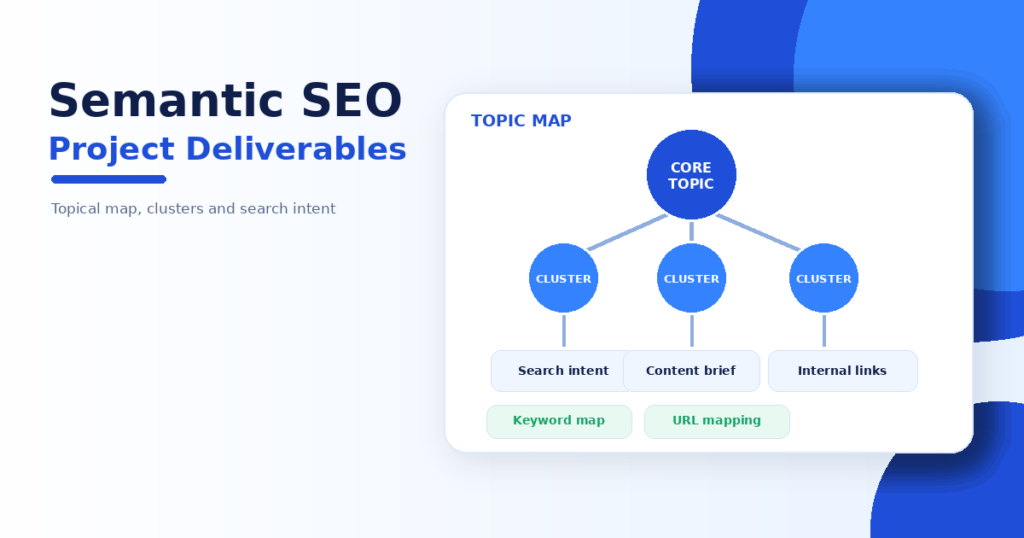
The full structure of pages: pillar pages, cluster pages and supporting pages, with URL paths. See how to build a topical map for how this works.
4. Search intent for each page
For every page, a note on why the visitor searches (learn, compare, hire or find a place) and what type of page ranks now. This prevents a blog post from being written for a query where only service pages rank, and the other way round.
5. Keyword map
One primary keyword for each page, plus supporting terms, so two pages do not compete for the same query. See how to cluster keywords.
6. Review of existing pages
A decision for each page you already have: keep, update, merge or remove. This is often where the fastest improvements come from.
7. Content briefs
A brief for each page: the question it answers, the direct answer, the outline, entities to cover, questions to use as headings and the links to place.
8. Internal link plan
Which page links to which, and with what anchor text. Parent, child and sibling links are planned instead of left to chance.
9. Schema and entity setup
Structured data for articles, services, the author and the business, matched to the visible text, plus consistent profiles across the web. See entity SEO.
What you usually need to provide
- Access to Google Search Console and, if possible, Analytics.
- A clear description of your services and customers.
- Your real experience, case studies and proof.
- Decisions on which services matter most.
What semantic SEO cannot do
- Guarantee rankings or AI citations.
- Fix a slow, broken or unindexed site on its own.
- Replace good content, links or real expertise.
Red flags when you hire
- A guaranteed ranking or a guaranteed “authority score”.
- A map made only by software with no intent check.
- Hundreds of thin pages in the plan.
- No review of your existing content.
- No explanation of how decisions were made.
FAQ
How long does a semantic SEO project take?
It depends on your site size and topic. A small site needs less planning than a large one. Ask any provider for a clear scope before you start.
Do I need to write the content myself?
Not always. But your real experience should be in the content. Briefs help a writer, or you, do it properly.
Is a topical map the same as a content calendar?
No. A topical map shows what pages should exist and how they connect. A calendar decides when to publish them.
Can I do this myself?
Yes. My guides explain each step. A specialist saves time, especially on larger sites.
Want a plan like this for your site? I can review your pages and map the structure. See my SEO and technical SEO services.
Related reading: semantic SEO vs traditional SEO and topical authority in SEO.
About the author: Hridoy Ahmed is an SEO specialist and WordPress security expert based in Dhaka, Bangladesh, with 8+ years of experience.