
By Hridoy Ahmed | Last updated: October 25, 2026 | 9 min read
Short answer: Semantic keywords are words and phrases that are connected to your main topic by meaning: synonyms, related ideas, questions and the things a reader expects to see. To find them, study “People also ask”, the headings of pages that already rank, your Search Console queries and the questions your customers really ask. Then use them only where they fit naturally.
Most people hear “semantic keywords” and think of a list of words to sprinkle into a page. That is not how it works. They are a way to check that your page covers the topic the way a reader expects. This guide shows how to find them and use them. For the bigger picture, see my semantic SEO guide.
What counts as a semantic keyword?
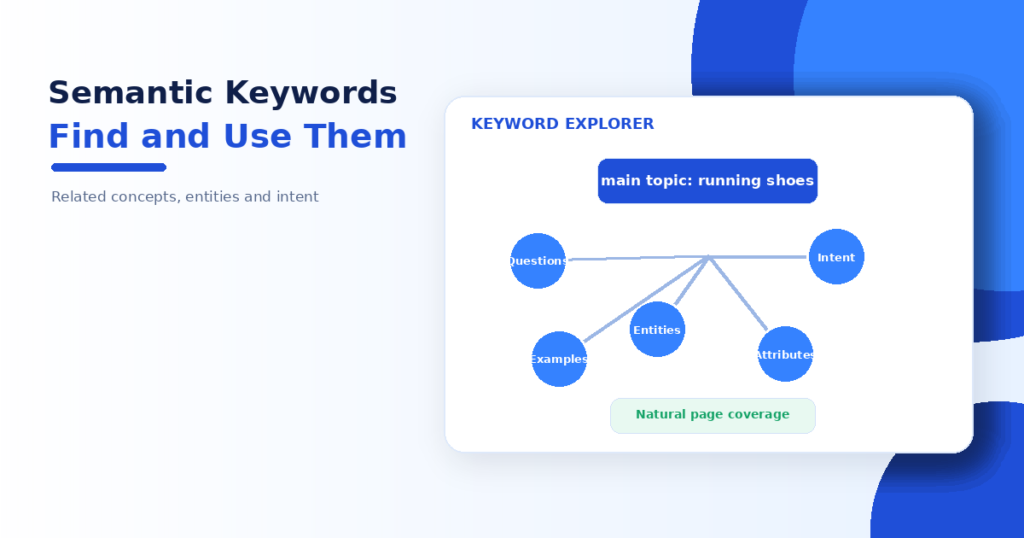
For the main keyword “WordPress malware removal”, semantic keywords could be:
- Synonyms and variations: clean a hacked WordPress site, remove malware from WordPress.
- Related things (entities): backup, plugin, firewall, Search Console, SSL.
- Questions: how do I know if my site is hacked? How do I remove the Google warning?
- Attributes: symptoms, causes, cleanup steps, cost, prevention.
Semantic keywords vs LSI keywords
You will often see the two terms mixed up. “LSI keywords” is an older term that is widely misused in SEO. The practical idea, covering related terms and entities, is still useful, but you do not need that label. I explain this in LSI keywords: do they exist?
5 ways to find semantic keywords
1. People also ask and related searches
Search your main keyword and note the repeated questions. They show what readers want to know next.
2. Headings of the top pages
Open the pages that rank. Write down the headings they share. Topics every page covers are probably expected by readers.
3. Search Console
In the Performance report, filter by your page and read the queries. They show what Google already connects to the page, including words you did not plan for.
4. Autocomplete
Type your keyword and watch the suggestions Google offers.
5. Real customer questions
Emails, chats and calls are the best source. If three clients ask the same thing, it belongs in your content.
How to use them on a page
- Group your list into subtopics. Each group is a section or a heading.
- Put the direct answer for the main question in the first two or three sentences.
- Use questions as headings where they fit.
- Mention related entities in the places where a reader would expect them.
- Check coverage afterward. My guide to entity coverage in SEO shows how.
Do not aim for a “density”. If a term does not help the reader, leave it out.
Mistakes to avoid
- Forcing a long list of terms into one page.
- Using synonyms without adding new information.
- Copying the competitor’s headings and nothing else.
- Mixing two search intents (guide and service) on one page.
FAQ
How many semantic keywords should I use?
There is no fixed number. Use as many as the page needs to answer the topic completely.
Are semantic keywords a ranking factor?
Google does not list them as one. They help you write content that covers a topic well.
Do I need a tool?
No. Search results, Search Console and a spreadsheet are enough to start. For more on tools, see my NLP SEO guide.
Want a keyword and topic map for your site? I do the research and map each keyword to the right page. See my SEO and technical SEO services.
Related reading: how to cluster keywords and semantic SEO vs traditional SEO.
About the author: Hridoy Ahmed is an SEO specialist and WordPress security expert based in Dhaka, Bangladesh, with 8+ years of experience.
Related reading: if you keep seeing “LSI keywords” advice, read why LSI keywords are a myth. To see how meaning-based search works, see semantic search examples.