
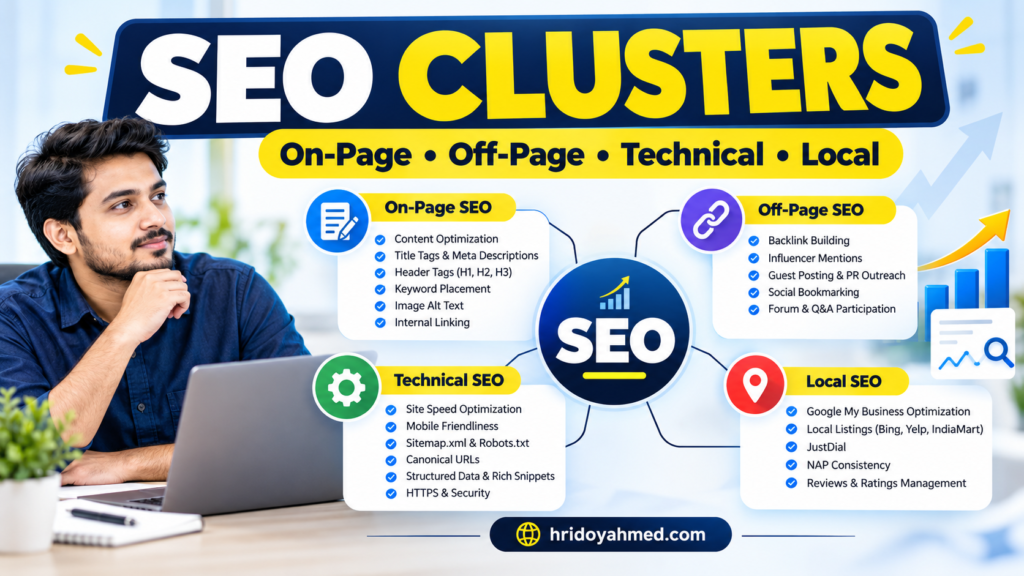
SEO clusters are groups of closely related topics, search queries, and pages organised around a clear subject and user intent. A practical SEO cluster helps you decide what to publish, how pages should link to one another, and how to cover a topic without creating competing pages. To build one, start with your audience’s questions, group keywords by intent, choose a main pillar page, create useful supporting pages, connect them with descriptive internal links, and improve the cluster using real search and conversion data.
This guide explains how to plan and implement SEO clusters across on-page, off-page, technical, local, and measurement work. It is designed for website owners, marketers, bloggers, and WordPress users who want a useful system—not a checklist of tactics performed without a goal.
What Are SEO Clusters?
An SEO cluster is an organised group of related search topics and content assets that collectively help a person understand or solve a broader problem. The cluster usually includes a comprehensive pillar page and supporting pages that answer narrower questions in greater depth. Internal links help readers move between these pages naturally.
For example, a broad topic such as WordPress SEO might include supporting articles about technical SEO, on-page optimisation, keyword research, schema markup, image optimisation, and measuring results. Each page should serve a distinct purpose. A cluster is not simply a collection of pages repeating the same keyword.
What a useful cluster contains
- A clear audience: who the content is for and what they need to accomplish.
- A central topic: the main subject that connects the supporting pages.
- Distinct search intents: informational, comparison, transactional, local, or navigational needs.
- A content structure: one suitable overview page and supporting pages where they add real value.
- Useful internal links: links that help people discover the next relevant answer.
- A measurement plan: a way to evaluate visibility, engagement, leads, and business outcomes.
Google does not require a website to use a formal “topic cluster” architecture to rank. Clusters are a planning method that helps you create helpful, logically connected content. They are not a ranking trick or a guarantee of higher positions.
Why Do SEO Clusters Matter?
They make content planning more useful
Instead of publishing isolated articles whenever a keyword appears, you can identify the questions your audience needs answered and plan content in a sensible order. This reduces gaps and helps you prioritise topics that support your business.
They improve discovery and navigation
Relevant internal links can help readers move from an overview to a detailed answer, and help search engines discover pages and understand how they relate. Links should be useful in context; adding dozens of links just to create a pattern is not the goal.
They help you spot overlapping pages
Two pages targeting the same intent may compete for similar queries or confuse readers. Mapping topics before writing makes it easier to decide whether a query deserves its own page, a section on an existing page, or an update to content you already have.
They connect SEO activity to business goals
A cluster can support a customer journey: a beginner learns the basics, compares solutions, and then reaches a relevant service or product page. The path should be helpful and transparent, not a forced sequence designed only to generate clicks.
SEO Clusters vs. Keyword Clusters vs. Topic Clusters
| Term | What it means | Example |
|---|---|---|
| Keyword cluster | Search queries grouped because they share intent and can often be answered by the same page. | “SEO cluster meaning,” “what is an SEO cluster,” and “SEO clusters explained.” |
| Topic cluster | A content architecture connecting a broad subject page with focused supporting content. | A WordPress SEO guide linked to focused guides on technical SEO and on-page SEO. |
| SEO cluster | A broader planning label that may combine related keyword groups, content, links, technical needs, and measurement. | A complete plan for growing visibility around local SEO services. |
People use these terms differently, so define them clearly in your own workflow. The most important question is practical: Can one page satisfy the intent behind these queries well, or does the user need a separate answer?
How to Build an SEO Cluster Step by Step
Step 1: Start with an audience problem
Begin with the task your audience wants to complete—not a keyword volume spreadsheet. Ask customers, review support questions, examine sales conversations, and look at queries in Google Search Console. Record the questions that repeatedly appear and the outcomes users want.
For a WordPress service business, audience problems might include slow pages, indexing issues, weak local visibility, confusing site structure, or uncertainty about which SEO work to prioritise.
Step 2: Research queries and related entities
Collect seed terms, synonyms, questions, comparisons, and related concepts. Sources may include Google Search Console, keyword research tools, site search, customer questions, competitor content, and search results. Treat third-party search-volume estimates as estimates, not exact demand.
Do not add a phrase simply because a tool suggests it. Keep it only if it reflects a real need relevant to your audience.
Step 3: Group keywords by intent, not just wording
Compare what searchers expect to see. “What is technical SEO?” asks for an explanation, while “technical SEO audit service” suggests someone may be evaluating a service. Those queries might belong to the same broad topic but usually need different page experiences.
For a practical method, see How to Cluster Keywords: A Step-by-Step Guide.
Step 4: Check existing pages before creating new ones
Export relevant URLs and query data from Search Console, then review each page’s topic, intent, impressions, clicks, conversions, and internal links. Decide whether to keep, improve, merge, redirect, or create content. Do not delete or redirect a useful URL merely because its traffic is currently low; check links, purpose, and historical value first.
Step 5: Choose the pillar page
The pillar page should cover the broad topic well enough to orient readers and point them to deeper answers. It does not need to contain every detail. A strong pillar defines the subject, explains the main decisions, gives practical steps, and links to supporting pages where the reader can go further.
Step 6: Plan supporting pages with distinct purposes
Each supporting page should answer a meaningful question or solve a specific problem. Before commissioning a new article, write one sentence describing its unique purpose. If that sentence is nearly identical to the purpose of an existing page, improve the existing page instead of creating a duplicate.
Step 7: Create a useful internal-link structure
- Link from the pillar to the most relevant supporting pages.
- Link from supporting pages back to the pillar when it helps readers understand the bigger picture.
- Connect related supporting pages when there is a genuine next step.
- Use descriptive anchor text that tells readers what they will find.
- Check that important pages are accessible through normal crawlable links.
There is no magic number of links for a cluster. Add links where they help navigation and comprehension, and remove links that feel repetitive or irrelevant.
Step 8: Publish, inspect, and improve
Check the page on mobile and desktop, verify that links work, confirm that the page can be indexed, and make sure its title and main heading accurately describe the content. Submit or inspect the URL in Search Console when appropriate. Then review performance over a sensible period and improve the content based on real user needs and query data.
The Five Practical SEO Clusters
The categories below are a practical operating framework. They are not official Google categories, and some activities overlap. For example, internal linking affects content architecture and technical discoverability, while local pages still need sound on-page SEO.
1. On-Page SEO
On-page SEO makes a page useful, clear, and easy to understand for its intended audience.
- Title tags: write a unique, accurate title that reflects the page’s main purpose.
- Meta descriptions: summarise the page honestly and give searchers a reason to choose it. Google may generate a different snippet.
- Heading hierarchy: use a clear main heading and descriptive subheadings to organise the answer.
- Keyword and entity coverage: use natural language and cover concepts needed to answer the question. Avoid repetition for its own sake.
- Image optimisation: use relevant images, sensible file sizes, and descriptive alt text when an image conveys information.
- Internal links: connect the page to relevant resources and next steps.
- Structured data: use eligible, accurate schema where it describes visible page content and meets the relevant guidelines.
How users benefit: they can understand the page faster, find the right detail, and decide what to do next. Read more in the practical guide to semantic SEO.
2. Off-Page SEO
Off-page SEO concerns signals and reputation beyond your own website. The goal should be to earn genuine recognition and useful referrals—not manufacture metrics.
- Editorial backlinks: create resources people have a reason to reference, and earn relevant links naturally.
- Digital PR: share original research, expert commentary, useful data, or stories with relevant publishers.
- Expert contributions: contribute useful insights to reputable publications where the audience is relevant.
- Brand mentions: build awareness through real expertise, partnerships, and customer experiences.
- Community participation: answer relevant forum and Q&A questions genuinely, following community rules and disclosing affiliations when needed.
Buying links to manipulate rankings, mass guest posting, automated forum links, and low-quality bookmarking campaigns can waste resources and create policy risk. Social shares can help people discover content, but they are not a guaranteed direct ranking boost.
3. Technical SEO
Technical SEO helps search engines access, crawl, render, and understand important content. It also helps visitors use the site reliably.
- Crawlability and indexability: check robots directives, HTTP status codes, canonical tags, and accidental noindex settings.
- XML sitemaps: include the canonical URLs you want search engines to discover; a sitemap is a hint, not a guarantee of indexing.
- Performance: measure real user experience and diagnose slow resources. Google’s Core Web Vitals include LCP, INP, and CLS.
- Mobile usability: ensure content and key actions work at common screen sizes.
- Canonical URLs and redirects: consolidate genuine duplicates carefully and preserve useful URL equity when changing URLs.
- Structured data: validate markup and ensure it matches visible content and current eligibility rules.
- HTTPS and security: keep certificates, software, access controls, and backups properly maintained.
Start with Google Search Console and PageSpeed Insights rather than making random changes. A page can be technically accessible and still not be indexed or rank; indexing and ranking depend on multiple factors.
4. Local SEO
Local SEO helps people find eligible businesses for location-related searches. It is especially important for service providers with a real local presence or service area.
- Google Business Profile: provide accurate business information and follow eligibility and representation rules.
- Consistent business details: keep name, address, phone, hours, and service information accurate across important listings.
- Local landing pages: create pages for real locations or service areas only when they provide unique, useful information.
- Reviews: request honest feedback from real customers and respond professionally. Never buy or fabricate reviews.
- Local relevance: show services, coverage areas, proof of work, contact details, and information that helps a local customer choose.
Directories vary by country and industry. Prioritise legitimate platforms your customers use instead of submitting identical listings to every directory available. Google explains that local results mainly depend on relevance, distance, and prominence; a business cannot control every factor.
5. SEO Tools and Measurement
Tools help you find evidence and make decisions; they do not replace judgement.
- Google Search Console: review queries, clicks, impressions, indexing information, and search appearance.
- Analytics: measure meaningful actions such as enquiries, purchases, sign-ups, or qualified leads.
- Crawlers: identify broken links, redirect chains, duplicate titles, and technical patterns across many URLs.
- Performance tools: use PageSpeed Insights and browser diagnostics to investigate speed issues.
- Keyword and backlink tools: use third-party databases to discover opportunities, remembering that their data is not Google’s own data.
- Content inventory: maintain a sheet of URLs, intent, cluster, owner, last review date, and next action.
Start with free first-party data where possible, then pay for tools only when their additional data helps you make better decisions.
Pillar Pages, Supporting Pages, and Internal Links
Example: a WordPress SEO content cluster
| Page role | Topic | What the reader should gain |
|---|---|---|
| Pillar | WordPress SEO: complete guide | A clear overview and a route to detailed answers. |
| Supporting | Keyword research and clustering | A repeatable method for grouping search intent. |
| Supporting | On-page SEO | Practical improvements to content and page elements. |
| Supporting | Technical SEO audit | A way to diagnose crawl, index, and performance problems. |
| Supporting | Semantic SEO | How entities, context, and topical coverage improve clarity. |
| Supporting | Local SEO | How eligible businesses improve local discoverability. |
| Conversion page | WordPress SEO services | A transparent way to enquire when professional help is needed. |
Do not create all of these pages just to fill a template. Publish a supporting page when you can provide a distinct, useful answer. If a good article already exists, improve it and link to it. Review your existing content before expanding the cluster.
How to choose anchor text
Use natural, descriptive wording such as “technical SEO audit checklist” when that accurately describes the destination. Avoid repeating the exact same keyword-rich anchor in every paragraph. The link should make sense to someone who has not seen your content plan.
SEO Clusters for AI Search, AEO, and GEO
AI Overviews, conversational search systems, and answer engines make clear, reliable, well-structured information valuable—but there is no separate guaranteed formula that forces a system to cite a page. Traditional SEO fundamentals remain important, and each platform may retrieve or present information differently.
Make the answer easy to identify
Answer the main question near the beginning, then explain the reasoning, steps, limitations, and examples. Use descriptive headings, concise definitions, lists, and tables where they genuinely help. Do not sacrifice nuance simply to make every answer short.
Demonstrate first-hand knowledge and trustworthiness
Include real examples, clearly attributed evidence, an accurate author profile, transparent business information, and practical experience where available. Cite primary sources for important factual claims. Never invent case studies, credentials, quotations, or performance results.
Keep content accessible and technically sound
Make important text available as crawlable page content, use meaningful links, avoid blocking essential resources, and maintain accurate canonical and indexing signals. Structured data can help machines interpret eligible content, but it does not guarantee a rich result or AI citation.
Use FAQs to answer genuine follow-up questions
Questions such as “How many pages should a cluster contain?” or “Should two similar keywords have separate pages?” can help readers make decisions. Write the answer users need rather than adding FAQs solely to target more keywords. FAQ markup does not guarantee an expanded search result.
For the wider context, read Semantic SEO: entities, topical maps, and topical authority. Follow Google’s current guidance on creating helpful, reliable, people-first content.
How to Measure SEO Cluster Performance
Set a baseline before publishing or making substantial changes. Compare similar time periods and account for seasonality, site changes, and changes in search demand. Small samples can fluctuate, so avoid drawing conclusions from a few days of data.
| Measure | What it tells you | Where to look |
|---|---|---|
| Impressions and clicks | Whether pages are appearing in search and attracting visits. | Google Search Console |
| Queries and landing pages | Which questions and pages are gaining or losing visibility. | Search Console |
| Indexing and crawl issues | Whether technical problems may prevent discovery or indexing. | Search Console and crawler |
| Conversions | Whether organic visitors take useful business actions. | Analytics or CRM |
| Referral quality | Whether earned mentions and links send relevant visitors. | Analytics and backlink tools |
| Content usefulness | Whether the page answers the question and supports the next step. | User feedback, engagement signals, enquiries, and editorial review |
There is no universal time in which a cluster should rank. Search engines need to discover and evaluate content, and results vary by competition, site history, query, and quality. Use a regular review schedule and make changes based on evidence, not promises of guaranteed rankings.
Common SEO Cluster Mistakes to Avoid
- Creating pages for every keyword variation: combine queries when the same page can satisfy the intent.
- Writing to hit a word count: cover the subject as thoroughly as users need, without padding.
- Publishing thin supporting articles: add a page only when it provides a distinct answer or useful experience.
- Over-optimising anchor text: use descriptive links naturally rather than repeating exact-match phrases.
- Ignoring existing URLs: audit current content before creating replacements or redirects.
- Confusing schema with rankings: valid structured data does not guarantee rich results or better positions.
- Buying low-quality links: prioritise relevant editorial recognition and real expertise.
- Ignoring conversion intent: traffic is useful, but the content should also help users take the right next step.
- Promising AI citations: no SEO or GEO tactic guarantees inclusion in AI-generated answers.
Frequently Asked Questions About SEO Clusters
What is an SEO cluster in simple terms?
An SEO cluster is a group of related topics and pages planned together so that each page answers a distinct question and relevant pages connect through useful internal links.
How many articles should an SEO cluster have?
There is no required number. A small cluster may need only a pillar and a few genuinely useful supporting pages; a broad subject may justify many more. Let audience needs and distinct search intents determine the size.
Are SEO clusters a Google ranking factor?
“SEO cluster” is not a named Google ranking factor. Clusters are a content-planning approach that can improve coverage, navigation, and internal linking. Rankings still depend on many systems and signals, and no cluster structure guarantees success.
What is the difference between a pillar page and a cluster page?
A pillar page introduces and organises a broad subject. A supporting cluster page explores one narrower question in depth. Both should be useful on their own and linked when the relationship helps readers.
Do all keywords need separate pages?
No. Group queries when they express substantially the same intent and can be answered well by one page. Create separate pages when the needs, audience, or expected result are meaningfully different.
Can small websites benefit from SEO clusters?
Yes. A small site can start with one important topic, a strong overview page, and a few useful supporting resources. A focused, well-maintained set of pages is better than publishing many thin articles.
How do I find keyword clusters?
Collect relevant queries, examine search intent and the pages ranking for them, group terms that can be satisfied by one page, and compare those groups with your existing content. Use keyword tools as research aids, then validate with your audience and Search Console data.
Should I use AI to create SEO cluster content?
AI can help brainstorm questions, organise research, and create outlines. A human should verify facts, add original insight, remove repetition, and ensure the final page genuinely helps its intended audience. Publishing many unreviewed pages simply to manipulate rankings is not a sound strategy.
Do SEO clusters help with AEO and GEO?
Clear topic coverage, accessible content, descriptive headings, useful internal links, and trustworthy evidence can make information easier to understand and retrieve. However, no structure guarantees that an answer engine will feature or cite a page.
Which tools should I use to manage a cluster?
Start with Google Search Console for search performance and indexing, an analytics tool for meaningful outcomes, and a spreadsheet or content inventory for URLs, intent, links, and review dates. Add paid keyword or crawling tools when they solve a specific research need.
How often should I update a pillar page?
Review it when the topic changes, supporting resources are added, data becomes outdated, users report gaps, or performance shows a meaningful problem. Do not change dates or rewrite content without a reason; make updates that improve accuracy and usefulness.
Conclusion: Build Clusters Around People, Not Just Keywords
A strong SEO cluster starts with a real audience need, groups queries by intent, gives each page a clear job, and connects related answers with helpful internal links. On-page, off-page, technical, local, and measurement work all support that goal, but none should be treated as a shortcut to guaranteed rankings.
Start with one subject that matters to your audience. Review what you already have, identify the biggest unanswered questions, improve your pillar page, and add supporting content only when it provides genuine value. Measure whether people can find the information and whether it helps them accomplish their goals.
Explore the SEO Cluster: Practical Supporting Guides
Use these focused guides to go deeper into each part of the process. Start with the pillar overview, then choose the specific answer you need.
- Internal Linking for SEO: A Practical Strategy for Topic Clusters — connect related pages and improve navigation.
- Search Intent in SEO: How to Match Keywords to the Right Page — decide which queries belong together.
- SEO Content Brief: How to Plan Helpful Articles Before Writing — plan useful supporting content before drafting.
- How to Cluster Keywords: A Step-by-Step Guide — group related search terms by intent.
- On-Page SEO Checklist: Titles, Headings and Internal Links — check key page elements before publishing.
- Technical SEO Checklist for WordPress — review crawling, indexing, and technical foundations.
- Semantic SEO: A Practical Guide to Entities, Topical Maps and Topical Authority — understand related concepts and topic coverage.
- What Is GEO and How Is It Different From SEO? — explore generative engine optimization.
- How to Optimize Your Google Business Profile — improve local business information.
- How Many Backlinks Do You Need to Rank? — understand backlink evaluation without chasing a fixed number.
These pages cover different questions, so you do not need to read them in a fixed order. Choose the guide that matches your current task.