
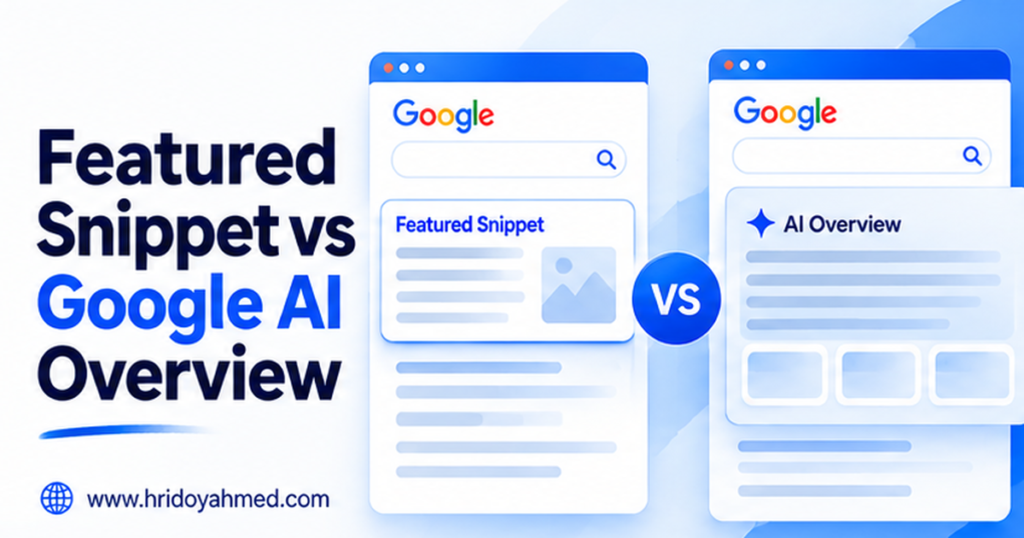
Quick answer: A featured snippet highlights an excerpt from one page near the top of Google Search, while an AI Overview generates an AI-written summary that may cite multiple supporting pages. You cannot manually mark a page as a featured snippet or guarantee an AI Overview citation. The practical strategy is to publish useful, accurate content and make sure Google can crawl, index and understand it.
Featured snippet vs AI Overview: at a glance
| Feature | Featured snippet | AI Overview |
|---|---|---|
| Presentation | An excerpt from a single page, often a paragraph, list or table | An AI-generated response with links to supporting sources |
| Source pattern | Usually highlights one page for the query | Can synthesize information from several sources |
| Trigger | Google’s systems decide when a snippet is useful | Google shows it when its systems determine an AI response adds value |
| Publisher control | No manual submission or special markup to request one | No special AI Overview schema or guaranteed placement |
| SEO foundation | Indexable, relevant, helpful page content | The same core SEO foundations, plus clear and trustworthy information |
What is a featured snippet?
A featured snippet is a search result in which Google displays a selected excerpt from a webpage to answer a query. It may appear as a paragraph, numbered list, bullet list, table or another format. Google chooses the page and excerpt algorithmically; there is no button in Search Console to apply for one.
What is a Google AI Overview?
An AI Overview is a generated summary shown for some searches when Google’s systems determine it is useful. It can include links to pages that help users explore the topic. It is not simply a longer featured snippet, and the exact sources and layout can vary by query, location, language and time.
Does ranking in a featured snippet guarantee an AI Overview citation?
No. These features are selected differently, and appearance in one does not guarantee appearance in the other. Strong organic visibility can help users discover a page, but there is no public formula that guarantees an AI Overview link.
How to optimize content for both features
1. Answer the main question early
Use a short, direct answer near the beginning of the relevant section. Then explain the conditions, steps, exceptions and evidence. Avoid padding the opening with a long personal introduction before answering the query.
2. Use question-led headings where they help
Write descriptive H2 and H3 headings that reflect real reader questions. Use lists for processes, tables for genuine comparisons and paragraphs for explanations. Do not force every section into a question if a clear descriptive heading works better.
3. Make claims specific and verifiable
Support important claims with first-party data, original examples, named sources or documented methods. Add a date when information changes frequently. Avoid invented statistics and claims such as “this guarantees AI citations.”
4. Make the page crawlable and indexable
Check that the page is not blocked by robots.txt, does not carry an unintended noindex directive, returns a successful HTTP status and has a sensible canonical. Use URL Inspection in Google Search Console to check the indexed version. Structured data should match visible page content, but it does not guarantee a special search feature.
5. Demonstrate real expertise
Show who created the content, relevant experience, how tests were performed and what limitations apply. For advice that can affect money, safety or security, use careful language and credible references.
6. Keep content original and useful
Do more than repeat the current results. Include a worked example, decision framework, original screenshot, dataset, checklist or experience-based explanation that genuinely helps the reader.
What not to do
- Do not add fake FAQ or HowTo schema to try to force an AI Overview.
- Do not assume a specific word count or heading pattern guarantees a snippet.
- Do not create many near-identical pages for slightly different keyword variations.
- Do not block important search crawlers without understanding the consequences.
- Do not sacrifice reader clarity for unnatural keyword repetition.
How to measure progress
Use Google Search Console to monitor impressions, clicks, queries and page performance. Compare periods and look for meaningful changes rather than assuming every AI Overview appearance is trackable as a separate metric. Check important queries manually across relevant devices and locations, but remember that search features can vary.
Frequently asked questions
Can I add schema to become a featured snippet?
No schema type guarantees a featured snippet. Use structured data only when it accurately describes visible content and follows Google’s documentation.
Are featured snippets going away because of AI Overviews?
They are different features and can coexist in search experiences. Which feature appears depends on the query and Google’s systems.
Does AI Overview SEO require a special file or plugin?
Google’s guidance says the same foundational SEO best practices apply; there is no special file or AI Overview schema requirement. Focus on helpful content and technical eligibility.
What should I prioritize first?
Fix indexing and crawlability problems, answer the query well, demonstrate trust, and measure real search performance before adding advanced tactics.
Related AI search guides
- Google AI Overviews and AI Mode: What Site Owners Should Know
- How to Optimize Your Website for AI Search
- Answer Engine Optimization (AEO)
- How to Measure AI Search Visibility
Official references: Google: AI features and your website · Google: Featured snippets and your website