
By Hridoy Ahmed | Last updated: October 2026 | 8 min read
Short answer: Entity coverage means how completely a page covers its main topic and the important related things: concepts, tools, people, places and terms. It is a content-planning idea, not an official Google metric. To check it, list the entities your topic needs, compare the list with your page and the search results, then add what is missing and skip what does not fit.
In this guide
- What entity coverage is
- Why it matters (and what is unproven)
- 6 steps to audit a page
- A simple example
- How it differs from entity SEO
- Common mistakes
- FAQ
What entity coverage is
An entity is a clearly identifiable thing: a person, a place, a company, a product, a tool or an idea. Every topic has a main entity and a set of related ones. A page about a hacked website, for example, naturally involves malware, backups, plugins, Search Console and a security scan.
Entity coverage asks one question: does this page deal with the important things a reader needs for this topic, and does it explain how they connect?
Why it matters (and what is unproven)
Readers who search a topic usually need more than one fact. A page that skips a key concept leaves them with another search to make. That is a real, practical reason to check coverage.
What is unproven: Google has not published an “entity coverage” score, and nobody outside Google can say that adding more entities improves rankings. Use this as a way to find content gaps, not as a ranking formula.
6 steps to audit a page
Step 1: Name the main entity and the search intent
Write one line: “This page is about X, for someone who wants Y.” If you cannot, the page is not focused yet. See search intent in SEO.
Step 2: List the related entities by type
Use simple groups:
- Concepts and terms: the ideas a reader must know
- Tools and products: what people use to do the job
- Organizations and people: who sets the rules or gives the guidance
- Problems and fixes: what goes wrong and how it is solved
Step 3: Check the real search results
Open the top pages for your query. Note which entities most of them mention. If every good result explains the same concept, it is probably important. Also check “People also ask” and your own Search Console queries. See my Google Search Console guide.
Step 4: Mark your page
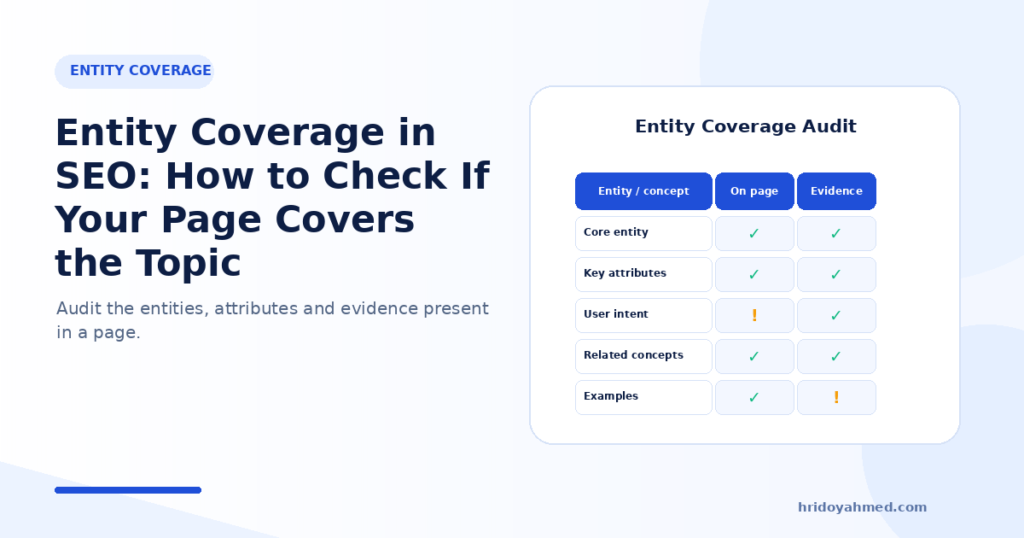
Next to each entity, write one of: covered well, mentioned only or missing. A short sheet is enough.
Step 5: Add what is missing, in the right place
Do not paste a list of names at the end. Give each important entity a short definition and one sentence that says how it relates to the main topic. Link to a deeper page if you have one. For specific, checkable facts, see Entity-Attribute-Value in SEO.
Step 6: Leave out what does not fit
Not every related thing belongs on the page. If adding an entity pulls the page away from the main intent, give it its own page or leave it out.
If you want this done across your key pages, see my SEO and technical SEO service.
A simple example
Take the topic “WordPress caching”. The main entity is caching. Related entities include page cache, browser cache, object cache, a CDN, cache purging, TTFB and caching plugins.
A page that only says “install a caching plugin” has a coverage gap. It never explains the different cache types, what a CDN adds, or when to clear the cache. A fuller page explains each in a sentence or two and shows how they fit together. See the caching setup guide for that kind of page.
How it differs from entity SEO
- Entity SEO is about helping search and AI tools understand your brand, authors and topics across the web.
- Entity coverage is about the completeness of one page or topic.
- Entity-Attribute-Value is about writing specific facts about each entity.
They work together, but each one answers a different question.
Common mistakes
- Adding a long list of names with no explanation
- Copying every entity from a competitor, even when it does not fit your reader
- Using a tool’s entity list as a rule instead of an idea
- Covering many entities shallowly instead of the key ones well
- Forgetting to link to the page that explains an entity in depth
FAQ
Is entity coverage a Google ranking factor?
Google has not said so. Treat it as a way to find gaps in your content.
How many entities should a page cover?
There is no number. Cover the ones a reader needs for the search and skip the rest.
Do I need a tool?
No. The search results, Search Console and a simple sheet are enough. A tool can give ideas, and you should check each one yourself.
Does this help AI search?
A page that explains its topic clearly and completely is easier for people and for AI tools to use. No one can promise AI citations. See how to optimize for AI search.
Not sure what your pages are missing? I review your key pages, mark the gaps and tell you what to add first. See my SEO and technical SEO service.
About the author: Hridoy Ahmed is an SEO specialist and WordPress security expert based in Dhaka, Bangladesh. He has 8+ years of experience and works with clients worldwide.