
By Hridoy Ahmed | Last updated: October 2026 | 7 min read
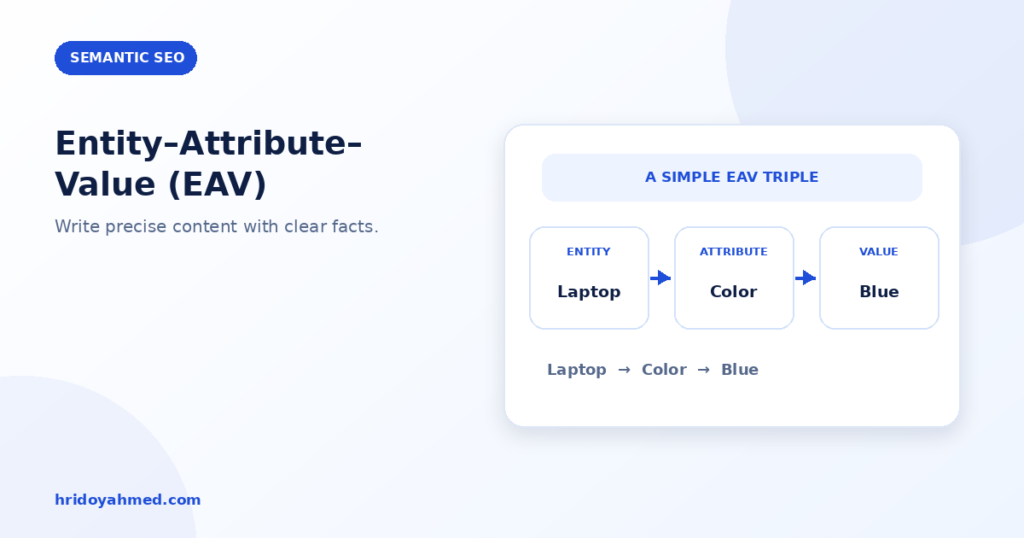
Short answer: Entity-Attribute-Value (EAV) is a simple way to list facts: an entity (a thing), an attribute (a property of it) and a value (the fact). In SEO, writers use it to plan specific, factual content instead of vague text. It is a planning method from the semantic SEO community, not a Google ranking factor.
In this guide
What EAV means
- Entity: the thing you write about, such as a service, tool, product or concept.
- Attribute: a property or question about it, such as cost, steps, time or risks.
- Value: the specific answer, such as a fact, a step or a number you can prove.
EAV forces you to write facts, not filler. If you cannot fill in the value, you do not yet have something concrete to say. I introduced the idea in my semantic SEO guide.
A simple example
Take “HTTPS” as the entity:
- HTTPS → purpose → it encrypts traffic between a visitor’s browser and your site.
- HTTPS → how to enable → install an SSL certificate, then redirect HTTP pages to HTTPS.
- HTTPS → common problem → mixed content, where some files still load over HTTP.
Each line is specific and checkable. A vague line such as “HTTPS is important for security” tells the reader nothing new.
How to use EAV when you plan content
- Pick the entity for the page. One page should have one main entity and one intent.
- List the attributes a reader needs. Use real questions, Search Console queries and the top results.
- Write the value for each attribute. Use facts and steps you can verify. Mark anything you cannot prove, and fix or remove it.
- Turn each attribute into a heading or a short section. Put the value first, in the first sentence.
- Add your own experience for the attributes where it matters.
- Put the list into your content brief. See how to plan an SEO content brief.
- Cover related entities on their own pages and link to them. See how to build a topical map.
If you want help turning your topics into specific, useful pages, see my SEO and technical SEO service.
What EAV is not
- It is not a Google ranking factor or a Google term.
- It is not a template that guarantees rankings.
- It is not a reason to write many thin pages, one per attribute.
- It does not replace first-hand experience, accuracy or good writing.
Common mistakes
- Listing attributes without real values
- Making a new page for every attribute
- Filling in values from memory without checking them
- Using made-up numbers to look specific
- Copying values from competitors without adding anything
FAQ
Is EAV the same as schema markup?
No. EAV is a planning method for writing. Schema markup is code that describes a page to machines. They share the idea of describing things with facts.
Do I need a tool for EAV?
No. A table with three columns is enough.
Does EAV help AI search?
Specific, factual, well-organized content is easier for people and tools to use. No one can promise that it will earn citations.
How many attributes should a page cover?
As many as the reader needs for that intent. Stop when the page answers the question completely.
Want content that is specific and useful? I plan and review pages around real facts and intent. See my SEO and technical SEO service.
About the author: Hridoy Ahmed is an SEO specialist and WordPress security expert based in Dhaka, Bangladesh. He has 8+ years of experience and works with clients worldwide.