
By Hridoy Ahmed | Last updated: October 2026 | 7 min read
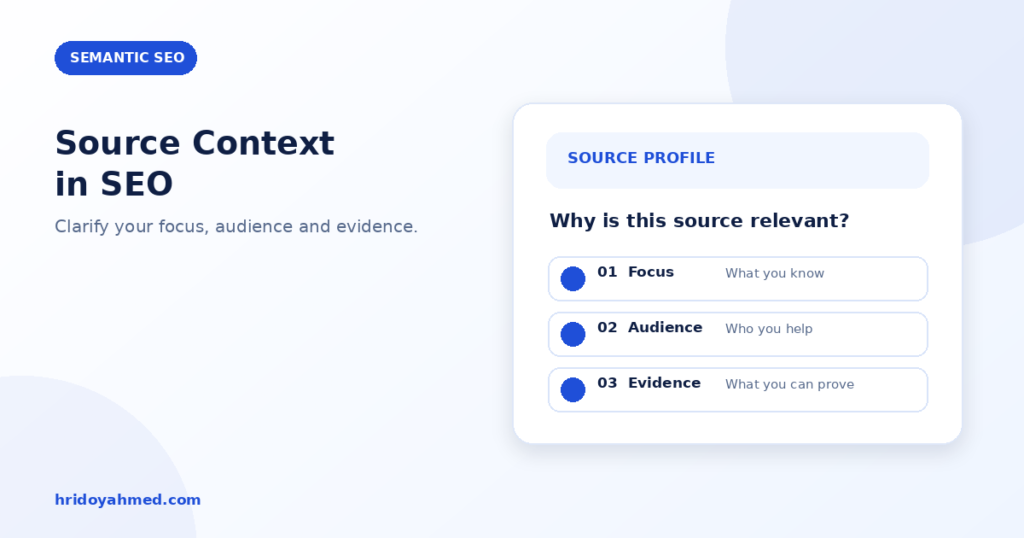
Short answer: Source context is a semantic SEO term for who you are, who you serve and why you are a fair source on a topic. It is your angle plus your proof. It is not a Google term or a ranking factor. Writing it down helps you stay focused, choose the right topics and make your About page, author boxes and pages consistent.
In this guide
What source context means
Every site has a reason to exist and a point of view. Source context is that reason, stated plainly: what the site is about, who it is for, and what gives its author the right to speak on it. The term comes from the school of semantic SEO associated with Koray Tuğberk Gübür. Google’s own documentation does not use it.
The idea fits what Google says it wants: helpful, reliable content that shows real experience. See my guide to E-E-A-T and my semantic SEO guide.
How to write yours
- Central topic: “This site is about [topic].” Keep it narrow and honest.
- Audience: “It is for [who], who need [what].”
- Angle: “I approach it by [your method or point of view].” For example, manual and white-hat.
- Proof: list facts you can show: years of work, real projects, real results, real tools. Only claim what you can back up.
- Boundaries: list what you do not cover. This protects your focus.
- Test it: read the sentence aloud. If it could describe any site, make it more specific.
Here is a short example based on this site: “This site is about SEO and WordPress work for site owners, written by an SEO specialist and WordPress security expert in Dhaka with 8+ years of experience, using manual, white-hat methods.”
Where it should show up
- About page: state who you are and link to your real profiles. See Who Is Hridoy Ahmed?
- Author box: the same short bio on every post.
- Service pages: explain your method and proof, not only a list of features.
- Posts: add first-hand examples and be clear about what you tested and what you did not.
- Profiles: keep your name, bio and links consistent. See entity SEO.
If you would like help writing and applying yours, see my SEO and technical SEO service.
Common mistakes
- Claiming credentials, awards or results you cannot prove
- Describing the site so broadly that it has no focus
- Writing about topics that do not fit your experience
- Using different bios and descriptions on different pages and profiles
- Treating source context as a ranking trick
FAQ
Is source context a Google ranking factor?
No. It is a planning term from the SEO community. It helps you build a focused, honest and consistent site.
How is it different from E-E-A-T?
E-E-A-T describes qualities of helpful content. Source context is your own written statement of focus, audience and proof, which helps you show those qualities.
Do I need to publish my source context?
Not as a separate page. Use it to shape your About page, author box and service pages.
Can I change it later?
Yes, when your work changes. Update every page and profile to match.
Want a clear focus for your site? I help you define your topic, proof and structure. See my SEO and technical SEO service.
About the author: Hridoy Ahmed is an SEO specialist and WordPress security expert based in Dhaka, Bangladesh. He has 8+ years of experience and works with clients worldwide.