
By Hridoy Ahmed | Last updated: October 2026 | 7 min read
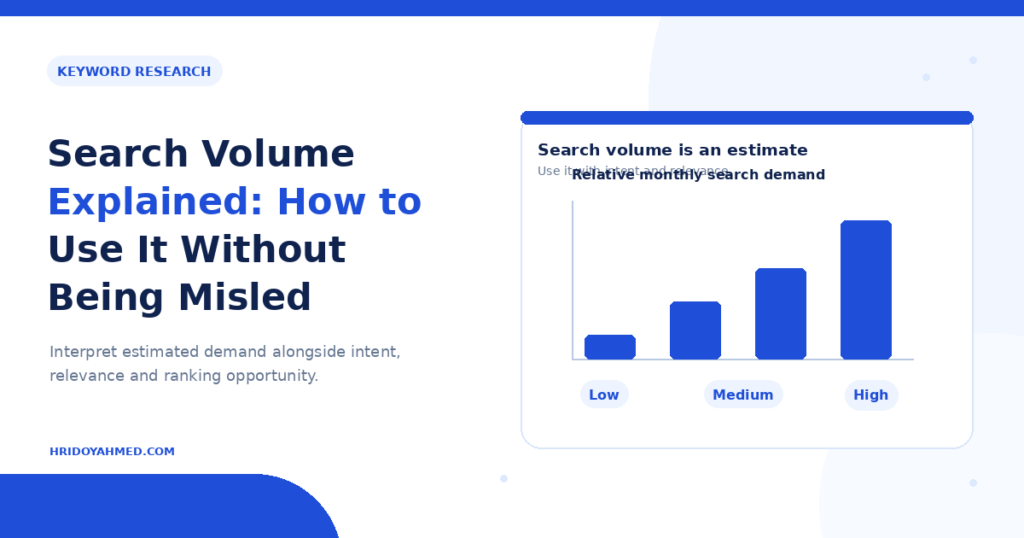
Short answer: Search volume is an estimate of how many times people search for a keyword in a month, usually averaged over a period. It is useful for comparing topics, but it is not exact traffic. Tools disagree, volume ignores intent, and many searches end without a click. Use search volume together with search intent, the real results and your own Search Console data.
In this guide
- What search volume is
- Where the numbers come from
- Five ways search volume misleads you
- How to use it well
- A simple example
- FAQ
What search volume is
Search volume is the estimated number of searches for a keyword, normally reported as a monthly average. If a tool shows 1,000 for a keyword, people searched that phrase about 1,000 times per month on average. It does not mean 1,000 visits to your page. Even a page at the top of the results does not receive every search.
Where the numbers come from
- Google Keyword Planner gives ranges, not exact numbers, unless you run active ads.
- Paid SEO tools estimate volume with their own data and models. Two tools can show different numbers for the same keyword.
- Google Search Console shows your own impressions and clicks. This is real data from Google, but it covers only the searches where your site appeared.
- Google Trends shows relative interest over time, not volume.
No source gives a perfect number, so compare keywords inside the same tool and treat the result as a rough guide.
Five ways search volume misleads you
1. It ignores intent
A keyword with a high volume may bring people who want to read, not buy. A keyword with a low volume may bring ready-to-buy customers. Read my guide on search intent.
2. It does not equal clicks
Search features such as AI answers, maps, ads and featured snippets take attention. Some searches end without a click. Check the real results page before you decide, as I explain in my SERP analysis guide.
3. It hides seasonality
An average hides peaks. A keyword may get most of its searches in two months of the year. Check the trend in Google Trends.
4. It groups many searches together
One topic has many wordings. A page that ranks well can collect traffic from dozens of related searches that no tool lists under one number.
5. It misses new and very specific searches
Tools often show zero or low volume for new topics and long, specific questions. Some of those searches still bring real visitors. See my guide on long-tail keywords.
How to use it well
- List your topics first. Start from what your customers ask, not from a tool. Keyword research with page-wise mapping is part of my SEO and technical SEO service, if you want help.
- Compare volume inside one tool. Use it to rank ideas, not to forecast traffic.
- Check intent. Open the results and see what Google shows. Match your page type to it.
- Judge business value. Ask whether a visitor from this keyword could become a customer.
- Check difficulty and your site. Read my guide on low-competition keywords.
- Use Search Console later. After you publish, your real impressions and queries teach you more than any estimate.
A simple example
Say a tool shows 5,000 monthly searches for “what is a backlink” and 90 for “backlink audit service for small business”. The first phrase brings readers. The second brings people who want to hire. If you sell audits, the second keyword may bring you more customers, even with a far lower volume.
The right choice depends on your goal. A guide for the first keyword can build trust, and a service page can target the second one.
FAQ
What is a good search volume?
There is no universal number. A good keyword matches your audience and your goal, and it can rank on your site. A small number with strong intent can beat a big number with weak intent.
Why do different tools show different search volume?
Each tool collects and models data differently. Use the same tool to compare keywords and do not mix numbers from different tools.
Should I target keywords with zero search volume?
Sometimes. If the topic matters to your customers and your site is the right place to answer it, a zero-volume keyword can still bring visitors. Check the results and your own data.
Is search volume a ranking factor?
No. Search volume is a measurement for you, not a signal that Google uses to rank your page.
How do I find the real volume for my site?
Use Google Search Console. It shows the impressions and clicks that your own pages receive. Read my Search Console guide.
Want keywords chosen for your business, not just for volume? I research search intent by hand and map each keyword to one page. See my technical SEO service.
About the author: Hridoy Ahmed is an SEO specialist and WordPress security expert based in Dhaka, Bangladesh. He has 8+ years of experience and works with clients worldwide.