
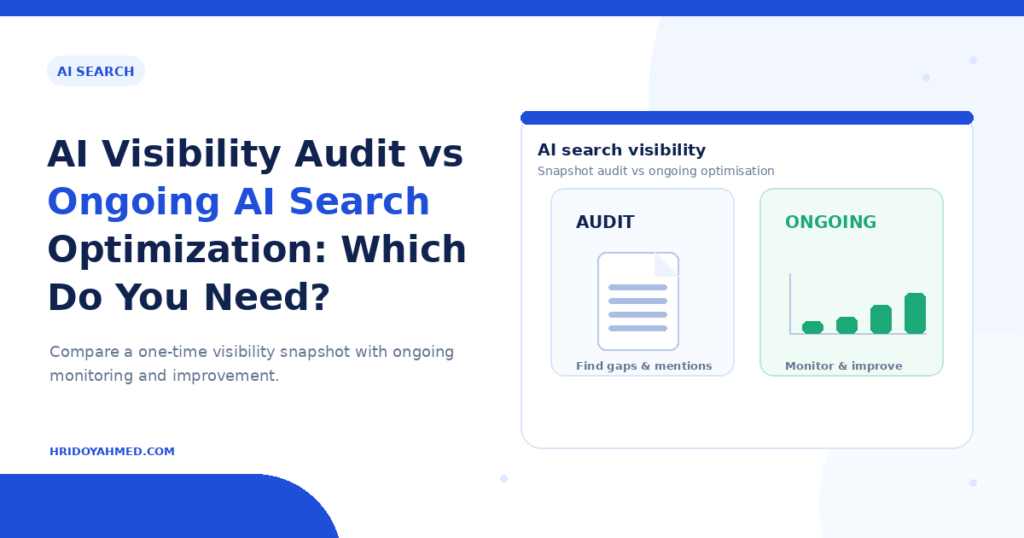
An AI visibility audit is a one-time snapshot: it shows how AI search tools currently see and mention your brand, and what blocks you. Ongoing AI search optimization is the repeated work after that: fixing the issues, improving content, and re-checking over time. Start with an audit if you are unsure where you stand. Move to ongoing work once you know what to fix and have the time or budget to keep at it. No one can guarantee that an AI tool will mention or cite you.
The difference at a glance
| AI visibility audit | Ongoing AI search optimization | |
|---|---|---|
| Type | One-time review | Repeated work over months |
| Question it answers | Where do we stand and what is blocking us? | Are we improving, and what should we change next? |
| Output | Findings, a baseline and a priority list | Implemented changes, new content, and repeat checks |
| Best for | First step, small budget, unclear problem | Sites with a clear plan and content to improve |
| Main risk | A list that nobody acts on | Paying for activity without measuring it |
What an AI visibility audit should cover
- Crawler access: can search and AI crawlers reach your pages? Check robots.txt and blocking rules. See my guide on AI crawlers and robots.txt.
- Indexing basics: are your key pages indexed in Google and Bing, and eligible to show with a snippet?
- Answer quality: do your pages answer real customer questions clearly, near the top?
- Brand and entity consistency: is your name, author, services and details consistent across your site and profiles?
- Structured data: is the markup accurate and matched to visible content?
- Baseline check: a fixed set of prompts checked on the tools you care about, with notes on whether you are mentioned, cited, or described correctly.
You can run a first check yourself with the AI search readiness checklist.
What ongoing AI search optimization involves
- Fix the issues the audit found, starting with access and indexing.
- Improve or add pages that answer the questions your customers ask.
- Keep facts, authors and business details up to date and consistent.
- Earn real mentions from trusted sites, without paid link schemes.
- Re-check the same prompts on a schedule and record what changed.
AI answers change from one check to the next, so a single result tells you little. Compare patterns across repeated checks. My post on how to measure AI search visibility explains what to record, and how to optimize your website for AI search covers the fixes.
How to choose
- Choose an audit if you have never checked how AI tools describe you, or you do not know whether crawlers can reach your site.
- Choose ongoing work if your basics are in place and you want steady improvement and tracking.
- Do both in order: audit first, then decide. This avoids paying for a long contract before you know what is needed.
Be careful with anyone who promises citations, a top spot in AI answers, or a secret method. The honest answer is that AI search is still changing, and some factors are not publicly documented. If you want a clear starting point, see my AI search optimization service.
Frequently asked questions
Is an AI visibility audit the same as an SEO audit?
No. An SEO audit looks at search rankings and technical health. An AI visibility audit adds checks on how AI tools mention and describe you, though the two overlap on crawling and content quality.
How often should I re-check AI visibility?
Use a fixed schedule, such as monthly, with the same prompts each time. Answers vary, so look at trends, not single results.
Can an audit guarantee that ChatGPT or Google will cite me?
No. An audit shows what to fix and gives you a baseline. It cannot control what an AI tool shows.
Do I need ongoing work if I already have good SEO?
Not always. Strong SEO covers many AI search basics. An audit can show whether anything extra is worth doing.
Want a clear starting point?
If you are unsure where your brand stands in AI search, I can help you check access, content and mentions, and decide what is worth doing next. See my AI search optimization service or contact me.
Related guides: What is GEO and how is it different from SEO?