
By Hridoy Ahmed | Last updated: October 26, 2026 | 8 min read
Short answer: Long-tail keywords are longer, more specific search phrases, such as “technical SEO checklist for WordPress” instead of “SEO”. Each one is searched less often than a short keyword, but together they make up a large share of all searches. They also usually show clearer intent, which makes it easier to write a page that fits. They are not always easy, so you still need to check the results.
In this guide
- What long-tail keywords are
- Long-tail keyword examples
- Why they are worth using
- How to find long-tail keywords
- How to use them on your site
- Long-tail keywords vs LSI keywords
- Common mistakes
- FAQ
What long-tail keywords are
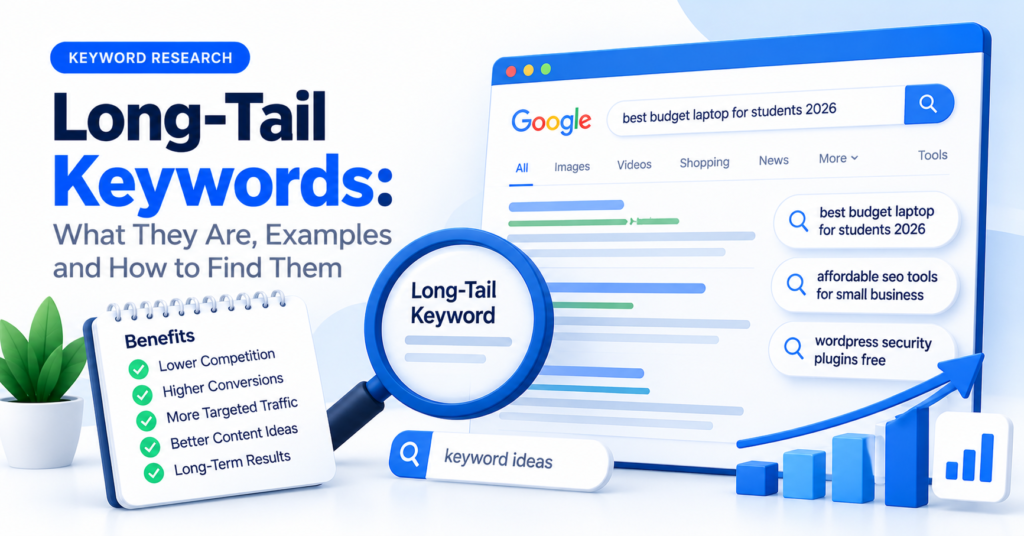
A long-tail keyword is a specific search with usually three or more words. The name does not come from the length of the phrase. It comes from the shape of search demand. A few popular terms get many searches (the “head”), and a very large number of specific terms each get few searches (the “long tail”).
People often type these searches when they know what they need. Someone who searches “WordPress malware removal service” is closer to hiring than someone who searches “WordPress”.
Long-tail keyword examples
| Short keyword | Long-tail version | What the searcher wants |
|---|---|---|
| SEO | technical SEO checklist for WordPress | A step-by-step list to follow |
| backlinks | how to check if a backlink is worth getting | A way to judge link quality |
| WordPress security | how to know if my WordPress site is hacked | Signs and checks |
| keyword research | keyword research for a new website with no budget | A free, beginner method |
| local SEO | how to get more Google reviews for a small clinic | Practical, honest steps |
Why they are worth using
- Clearer intent. A specific phrase tells you what the person wants, so it is easier to write the right page.
- Often less competition. Fewer sites target very specific searches, though this is not always true. See my guide to low-competition keywords.
- Better fit for new sites. A small site can start with narrow topics and grow its reach step by step.
- They support bigger topics. A group of long-tail posts can lead readers to a main page. See SEO clusters.
The trade-off is volume. One long-tail page brings fewer visitors than a top keyword would. You win by covering many of them well, not by expecting one to do everything.
How to find long-tail keywords
- Start from a short keyword. Take the main term for your service or topic.
- Use Google autocomplete. Type the term and note the suggestions. Add letters or words like “how”, “for” and “vs” to see more.
- Check “People also ask” and related searches. They show the questions people ask next.
- Read Google Search Console. The Queries report shows long searches that already bring impressions. Many are phrases you never planned for.
- Listen to your customers. The questions people send you by email or chat are real long-tail searches.
- Use a keyword tool for volume and difficulty. Many tools have a question filter or a “long-tail” view. Treat the numbers as estimates. My guide on how to do keyword research shows the full process.
- Check the results. Search the phrase and see what Google shows. See SERP analysis for SEO.
How to use them on your site
- One main phrase per page. Closely related phrases can often be answered on the same page.
- Group by topic. Cluster similar phrases before you write. See how to cluster keywords.
- Match the intent. If people want a guide, write a guide. If they want to hire, use a service page.
- Answer first. Put the direct answer near the top, then explain.
- Link up to the main page. Send readers from each long-tail post to the related service or pillar page. If you want help turning your keyword list into a plan, see my SEO and technical SEO service.
Related words and synonyms will appear naturally as you write. You do not need a special tool for that. See my guide on LSI keywords for what to use instead.
Long-tail keywords vs LSI keywords
These two are often mixed up, but they are not the same thing.
- Long-tail keywords are specific search phrases that you target, such as “best stainless steel drip coffee maker for home”. They are usually three or more words and show a clear need.
- “LSI keywords” is a popular name for related words and topics that belong on the page, such as “carafe”, “brew time” and “descaling”. The label is not a Google term, and Google’s John Mueller has said LSI keywords do not exist.
In short, a long-tail keyword is the search you aim at. Related terms are the words that appear naturally when you cover that search well. You can use both on one page. For the full explanation and a comparison table, read my guide on LSI keywords: are they real?
Common mistakes
- Thinking longer always means easier. Some long phrases are still hard. Always check the results.
- Making a page for every tiny variation. This can create pages that compete with each other.
- Chasing very low volume only. A phrase nobody wants brings no value, even if it is easy.
- Ignoring intent. A phrase with the wrong page type will not rank well.
- Forcing the full phrase into the text. Write naturally, and use the phrase in the title and a heading where it fits.
FAQ
What is a long-tail keyword?
A specific, usually longer search phrase with a clear need behind it, such as “how to remove malware from a WordPress site”.
How many words is a long-tail keyword?
There is no official rule. Many people use three or more words, but the idea is about being specific.
Are long-tail keywords better than short keywords?
Not always. They are often easier to match and to compete for, and short keywords can bring more traffic. A good plan uses both.
Do long-tail keywords convert better?
They often show clearer intent, which can help, but results depend on your offer and your page. I cannot promise a specific result.
Where can I find long-tail keywords for free?
Google autocomplete, “People also ask”, related searches and Google Search Console are free sources.
Want a long-tail plan for your site? I help find the searches your customers use and match them to the right pages. See my SEO and technical SEO service.
About the author: Hridoy Ahmed is an SEO specialist and WordPress security expert based in Dhaka, Bangladesh. He has 8+ years of experience and works with clients worldwide.