
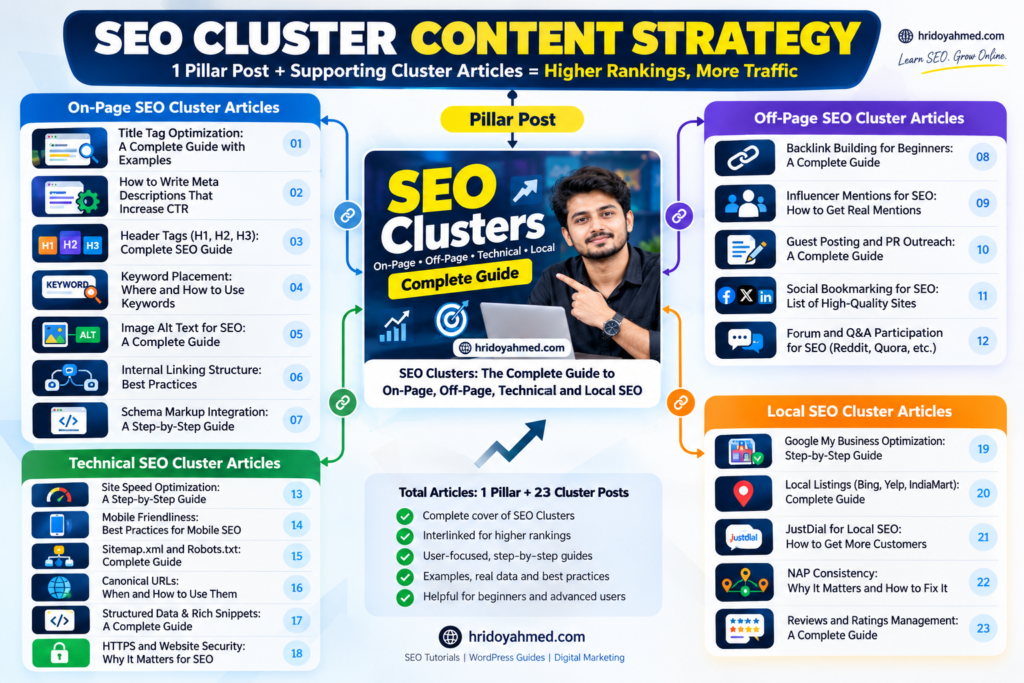
An SEO content brief is a short plan that defines who an article is for, what question it should answer, what evidence it needs, and how it fits the rest of your website. A useful brief records the primary intent, proposed title, key subtopics, questions to answer, internal links, sources to verify, and the action a reader may want to take next. It helps writers create focused, helpful content instead of padding an article to reach a word count.
This is especially useful when expanding a pillar page into a connected SEO cluster: every supporting article needs a distinct purpose.
What to Include in an SEO Content Brief
- Audience: who the page serves and what they already know.
- Reader problem: the specific question or task the page should resolve.
- Search intent: informational, comparison, transactional, navigational, local, or mixed.
- Primary topic: a natural description of the page’s main subject.
- Supporting concepts: related entities and subtopics needed for a complete answer.
- Proposed structure: a logical H1, H2s, and H3s—not headings added just to repeat keywords.
- Evidence: primary sources, verified facts, original examples, and any limitations.
- Internal links: relevant existing pages and suitable destinations for future links.
- Success measure: the user outcome or business action the content supports.
A Practical SEO Content Brief Template
| Field | What to write |
|---|---|
| Working title | A clear title that accurately represents the page. |
| Audience | The reader’s role, experience, and problem. |
| Main question | The question the article must answer directly. |
| Intent | What the searcher expects to learn or do. |
| Unique value | What examples, process, expertise, or clarity this page adds. |
| Outline | Sections arranged in the order readers need them. |
| Sources | Reliable evidence to verify before publication. |
| Internal links | Relevant pillar, supporting, and conversion pages. |
| Quality checks | Accuracy, readability, mobile experience, working links, and indexing settings. |
How to Create the Brief Step by Step
1. Review existing content first
Search your own site for pages covering the topic. Decide whether the right task is to update an existing page or create a genuinely different resource. This helps reduce duplication and preserves useful URLs.
2. Research questions and intent
Use Search Console, customer questions, search results, and keyword research tools to understand what people need. Treat search-volume estimates as directional, and do not assume a keyword list proves what readers want.
3. Build an outline around decisions
Arrange sections so the reader gets the direct answer first, then the explanation, steps, examples, trade-offs, and next actions. Include a table, checklist, or FAQ only when it makes the information easier to use.
4. Add evidence and first-hand insight
Identify claims that need checking. Prefer primary documentation and reputable sources. Add genuine examples or experience where available, and never invent results, quotes, credentials, or statistics to make an article appear authoritative.
5. Plan internal links
Link to the relevant SEO clusters pillar and to specific supporting resources such as the keyword clustering guide or semantic SEO guide. Use anchor text that describes the destination.
6. Review the finished article against the brief
Confirm that it answers the main question, meets the expected intent, uses accurate headings, supports important claims, has working links, and offers a sensible next step. Remove repetitive sections and any unsupported claims.
SEO Content Briefs and AI Writing
AI tools can help brainstorm subtopics, organise outlines, and identify questions worth researching. They can also produce confident errors or generic text. A human editor should verify claims, add original value, check sources, and ensure the final article is written for its audience. Search visibility should not be pursued by publishing large volumes of unreviewed, interchangeable pages.
Frequently Asked Questions
How long should an SEO content brief be?
Long enough to align the writer on audience, intent, outline, evidence, and links. A straightforward post may need one page; a technical or regulated topic may need a more detailed brief.
Should a brief specify word count?
You can estimate scope, but there is no universally ideal word count. The article should cover the subject as thoroughly as readers need without padding.
Does every article need an FAQ?
No. Include frequently asked questions when they address real follow-up needs. Do not add repetitive questions just to increase length or chase a special search display.
How does a content brief support topical authority?
It helps each article serve a clear role within a wider subject, connect to relevant pages, and add distinct value. It does not guarantee authority or rankings by itself.
Next Step
Use this brief template for your next supporting article, then connect it to the complete SEO clusters guide so readers can move from the overview to the detailed answer they need.