
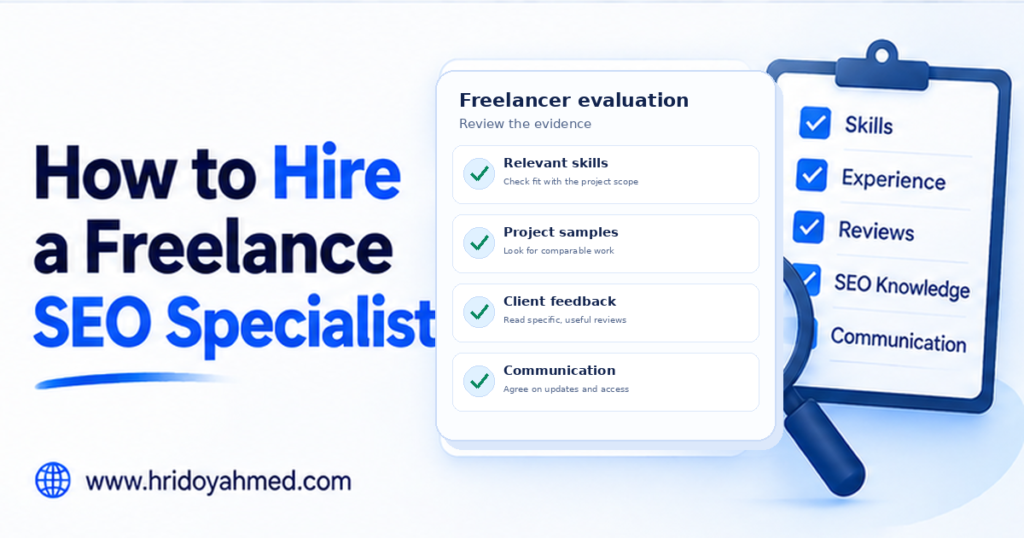
To hire a freelance SEO specialist, define the business outcome you need—such as more qualified enquiries, better local visibility, stronger technical health, or improved organic traffic—then compare specialists based on relevant experience, a clear work plan, transparent reporting, and realistic expectations. Do not choose only by the lowest price, a “guaranteed #1 ranking” promise, or a large list of backlinks. A trustworthy freelancer should explain what they will do, why it matters, what access they need, and how progress will be measured.
This guide is for business owners, including companies targeting customers in the United States, who want to hire an SEO freelancer without wasting budget or handing over a website blindly.
1. Decide what kind of SEO help you need
| Your situation | Service to consider | What good work should deliver |
|---|---|---|
| Indexing or crawl issues | Technical SEO audit | Prioritized findings, evidence, and safe fixes |
| Low local visibility | Local SEO | Accurate business details, useful local pages, and a measurement plan |
| Impressions but few clicks | On-page SEO and content improvement | Better intent match, clearer titles, and performance tracking |
| Launching a site or service | Keyword research and strategy | A prioritized page and content plan |
| Traffic loss after redesign or migration | Technical investigation | Review of redirects, indexability, canonicals, and internal links |
| Ongoing improvement | Monthly SEO support | Defined deliverables, implemented work, and reporting |
If you do not know the cause of a problem, consider a scoped audit before signing a long retainer. A useful audit prioritizes issues by evidence, impact, effort, and risk—not simply exports hundreds of tool warnings.
2. Where to find a freelance SEO specialist
- Referrals: ask business owners or developers about specialists whose work they have seen.
- Freelance marketplaces: inspect completed work, feedback, scope, and communication—not just ratings.
- Professional websites and LinkedIn: look for clear services, useful public work, and a consistent history.
- Specialist communities: observe whether the person explains trade-offs and solves problems rather than only promoting services.
A polished website or a large social following does not prove competence. Ask for evidence relevant to the work you need.
3. Evaluate experience and proof
Ask for relevant examples
Ask the freelancer to explain one or two projects similar to yours. Useful evidence could include a properly contextualized Search Console trend, the problem diagnosed, changes implemented, time period, and other factors that may have influenced results. A responsible specialist will distinguish what they know from what they infer and will not disclose client-confidential data without permission.
Check reasoning, not just the tool list
SEO tools can help with research and diagnostics, but buying tools does not make someone a strong specialist. Ask how they prioritize findings, validate search intent, and decide whether a proposed change is worth implementing.
Look for clear communication
A good freelancer explains technical findings in plain language, answers questions without pressure, and documents planned changes. Clear communication before hiring usually makes project management easier later.
4. Questions to ask before hiring
- What would you investigate first on a website like mine, and why?
- Which deliverables will I receive in the first 30 days?
- What access do you need, and can you use least-privilege permissions?
- Will you implement changes or only provide recommendations?
- How will you measure and report progress?
- How do you prioritize technical fixes, content, and link-related opportunities?
- What would make you advise me not to buy a particular service?
- Who owns the content, reports, accounts, and work products when the contract ends?
- What is excluded from the quote, and what could cost extra?
- What do you need from my team to avoid delays?
Pay attention to the answers. Questions about customers, services, location, competition, and business goals are often more meaningful than a quick promise to rank a broad keyword.
Freelancer vs agency vs in-house: which fits a small business?
| Option | Best when | Watch out for |
|---|---|---|
| Freelancer | You need focused work (an audit, technical fixes, local SEO) and want to talk to the person doing it. | One person has limited capacity and may not cover every skill. Ask who covers holidays and illness. |
| Agency | You need several specialists at once, such as content, development, PR and reporting. | Higher cost, and the person you meet in the sales call may not be the one doing the work. Ask who will. |
| In-house hire | SEO is a daily, long-term need across a large site or several teams. | Salary, tools and training cost more than a project. One hire rarely has every skill. |
For many small businesses, a freelancer is a sensible first step: start with a scoped audit, then decide whether ongoing work is worth it. Whichever option you choose, ask for a written scope, the name of the person doing the work, and clear reporting.
5. Understand pricing and scope
Freelance SEO pricing varies with experience, market, complexity, competition, deliverables, and implementation effort. There is no single fair price for every website. A low quote can become expensive if it excludes the work you actually need.
- Fixed-scope project: suitable for an audit, migration review, keyword map, or specific implementation.
- Hourly consulting: useful for limited expert diagnosis or advice.
- Monthly retainer: appropriate for ongoing work with a clear scope and review cycle.
- One-time setup: useful for a defined configuration, but not a guarantee of long-term rankings.
Get a written scope covering deliverables, deadlines, access, revisions, reporting, communication, payment milestones, and cancellation terms. Clarify whether content, developer implementation, outreach, link costs, and third-party subscriptions are included.
6. Red flags to watch for
- Guaranteed rankings: no freelancer controls Google’s results or can guarantee a position.
- Secret methods: vague claims are not a substitute for an explainable plan.
- Bulk links with no quality review: quantity alone does not create value and can create risk.
- Unverifiable reports: screenshots without dates, context, or a clear source are weak evidence.
- Unnecessary access: a freelancer should request only permissions needed for the work.
- Account ownership pressure: critical business accounts should remain under your control.
- Unclear deliverables: “SEO work” alone is not a sufficient scope.
- Pressure to sign immediately: take time to review and compare proposals.
7. Protect your website and accounts
- Keep ownership with your business. Domain, hosting, analytics, and Search Console should remain under accounts you control.
- Use individual user access. Avoid sharing personal passwords; grant only the permissions required.
- Back up before risky changes. For migrations, redirects, or major technical work, have a tested backup and rollback plan.
- Agree on approval rules. Decide whether changes can be published directly or require review.
- Review access regularly. Remove access when the engagement ends.
- Document changes. Record redirects, metadata changes, technical fixes, content updates, and dates.
For WordPress, clarify who handles backups, staging tests, plugin updates, and recovery if a change causes a problem. SEO and security overlap, but they are different services; confirm both are included if you need both.
8. Measure whether the freelancer is doing good work
Agree on a baseline before work begins. Choose measures tied to your business goal, not just one ranking or third-party authority score.
- Visibility: relevant queries, impressions, clicks, and page trends in Google Search Console.
- Qualified outcomes: calls, enquiries, bookings, or sales when tracking is configured correctly.
- Technical health: resolution of agreed crawl, indexing, redirect, or performance issues.
- Content progress: pages improved or created for a clear reason.
- Delivery: completed work against the written scope and schedule.
SEO results depend on the site, competition, implementation, and other factors. Review completed work and leading indicators alongside business outcomes; avoid judging only on short-term fluctuations.
9. A practical 30-day hiring plan
Week 1: define and shortlist
Write down your goal, website, target customers and locations, known issues, budget, and success measures. Shortlist candidates with relevant experience.
Week 2: compare proposals
Ask candidates to describe their initial investigation, deliverables, assumptions, access requirements, timeline, and exclusions. Compare clarity and relevance, not only price.
Week 3: agree on a clear first scope
Where practical, begin with a defined audit or first-month plan. Confirm permissions, approvals, backups where needed, reporting, and communication in writing.
Week 4: review work and next priorities
Check whether the agreed work was delivered and the findings are understandable. Decide whether to continue based on work quality, communication, and fit—not a promise of instant rankings.
10. Special considerations for businesses targeting the USA or UK
Before you sign, run these seven quick checks on any candidate: (1) they can explain what they would look at first on your site; (2) they show relevant work with honest context; (3) they give a written scope with exclusions; (4) they ask for least-privilege access only; (5) they agree to report against your business goal; (6) they name who does the work; (7) they promise no guaranteed rankings. A freelancer who fails two or more of these is worth skipping.
If your customers are in the United Kingdom, confirm the specialist knows UK search results, local terms and spelling, and the pricing and invoicing format you need (GBP, VAT where relevant).
If your customers are in the United States, ensure the specialist understands your target cities or states, customer intent, local competitors, and relevant search results. Being physically located in the USA is not automatically necessary for every SEO task; relevant market knowledge, communication, data access, and delivery matter more. For local businesses, location-specific knowledge can be especially important.
Agree on time zones, meeting windows, currency, invoicing, and response expectations. Ask for examples relevant to your industry and target locations if a freelancer claims US-market experience.
Frequently asked questions
How do I hire a freelance SEO specialist?
Define your goal, shortlist specialists with relevant experience, request a clear proposal, check evidence, agree on deliverables and measurement, and grant only the access required.
How much does a freelance SEO specialist cost?
Costs vary with experience, scope, competition, and implementation needs. Compare written deliverables and exclusions instead of choosing on headline price alone.
Should I hire a freelancer or an agency?
A freelancer can suit focused expertise and direct communication. An agency may suit projects requiring several specialists. Compare the actual people doing the work, accountability, scope, and total cost.
Can an SEO freelancer guarantee first-page rankings?
No. Results depend on factors outside a freelancer’s control. Be cautious of guaranteed rankings, guaranteed traffic, or unexplained shortcuts.
What should an SEO proposal include?
It should cover the objective, assumptions, prioritized tasks, deliverables, timeline, access, reporting, price, exclusions, approval process, and cancellation terms.
How long does SEO take to show results?
There is no universal timeline. It depends on site condition, competition, content, implementation speed, and other factors. Track changes over time rather than expecting a fixed result by a guaranteed date.
What access should I give an SEO freelancer?
Give only the permissions required, use separate user accounts where possible, retain ownership of key business accounts, and remove access when no longer needed.
Final checklist before you hire
- The business goal and scope are written down.
- The specialist explains their approach clearly.
- Examples are relevant and presented honestly.
- Deliverables, price, timeline, and exclusions are clear.
- Reporting connects to business goals.
- Account ownership, permissions, backups, and approvals are agreed.
- No one promises guaranteed rankings or secret shortcuts.
Hiring the right SEO specialist is about finding someone who can diagnose your situation, explain trade-offs, deliver useful work, and measure progress honestly. Start with a clear scope, protect your accounts, and expand the engagement only when the work supports your business goals.
Related reading: Google Search Console guide and step-by-step SEO audit guide.