
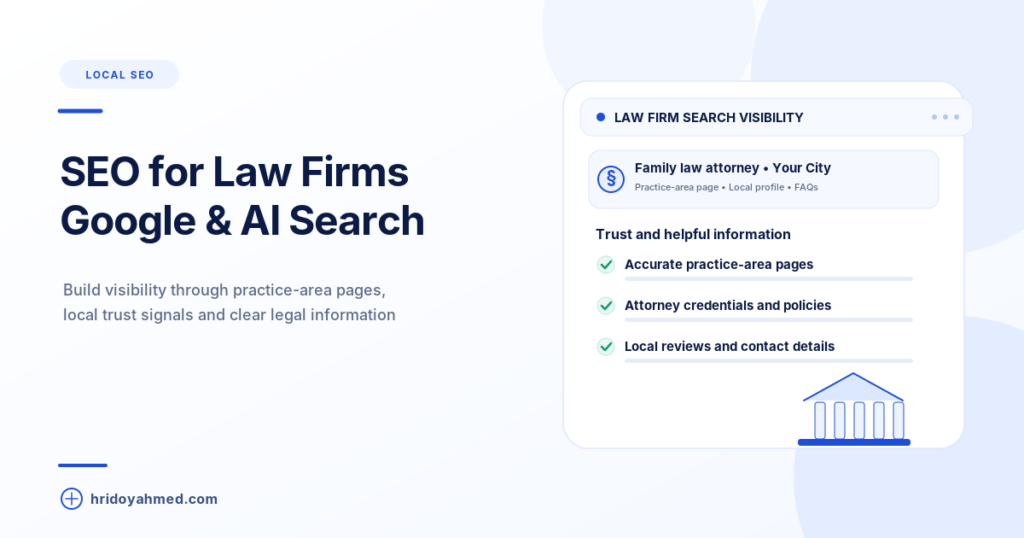
Law firm SEO means making your firm easy to find and easy to trust when someone searches for a lawyer on Google, Google Maps or an AI assistant like ChatGPT. The work is the same for both: clear practice area pages, a strong Google Business Profile, real reviews and consistent details about your firm. I cannot promise rankings or AI citations, but these steps give you the best honest chance.
I am Hridoy Ahmed, an SEO specialist with 8+ years of experience. I work with clients worldwide, remotely. Below is how I would approach a law firm website.
Why law firm SEO is different
People who search for a lawyer are often stressed and in a hurry. They search things like “divorce lawyer near me” or “car accident attorney in Dallas”. Google treats legal content as a topic where accuracy matters a lot, so thin or copied pages do badly. Your site must show who you are, where you practice and why a visitor can trust you.
One more point: advertising rules for lawyers differ by country and state. In the US, state bar rules apply. In the UK, the SRA sets rules for solicitors. Always check your regulator’s guidance before you publish claims about results or “best lawyer” wording.
Step 1: Build one page per practice area
Do not put all your services on one page. Create a separate page for each practice area, such as family law, personal injury or immigration. Each page should target one main search intent.
- Start with a direct answer: what you do and who you help.
- Explain the process in simple steps.
- Add a short FAQ with plain-text answers.
- Show the attorney’s name, bar or SRA registration and office address.
- Add one clear call to action: call, form or WhatsApp.
Step 2: Fix your local SEO
Most legal searches have local intent. Your Google Business Profile is often the first thing a client sees.
- Choose the correct main category and add secondary categories.
- Keep your name, address and phone number the same everywhere online.
- Add your real office photos and opening hours.
- Ask real clients for reviews and reply to them. Never buy or fake reviews.
- Create service area or office location pages only if you really have an office or serve that area.
If you would like help with this, see my local SEO service.
Step 3: Show trust signals (E-E-A-T)
Google asks for experience, expertise, authority and trust, especially for legal topics. Add:
- Attorney bios with real credentials.
- Author name and a “last reviewed” date on legal articles.
- Links to official sources such as court or government sites.
- A clear privacy policy and disclaimer.
Step 4: Write content that answers real client questions
Blog posts support your practice pages. Write about the questions clients really ask, like “How long does a divorce take?” or “What should I do after a car accident?”. Use your own experience and keep the legal facts accurate and dated. Each article should link to the matching practice page.
Step 5: Make your site AI-ready
AI search is not a separate job. It uses the same foundation as SEO. AI tools tend to pull from pages that are clear, well structured and from sources they can verify. To help:
- Put the direct answer in the first two or three sentences of each page.
- Use clear headings, written as questions where it fits.
- Add FAQ content that is visible on the page, and match schema markup to it.
- Keep your firm name, attorney names and address consistent across your site, directories and profiles.
- Make sure search engines and AI crawlers can reach your pages (check robots.txt and rendering).
Nobody outside the AI companies knows exactly how citations are chosen, so treat this as good practice, not a guarantee. If you want help, see my AI search optimization service.
Step 6: Technical basics
- HTTPS and fast loading on mobile.
- A clean XML sitemap submitted to Google Search Console.
- Click-to-call buttons that work on phones.
- No duplicate or near-identical city pages.
Common mistakes law firms make
- Copying practice area text from other firms.
- Making dozens of “lawyer in [city]” pages with the same text.
- Buying cheap backlinks from spam sites.
- Promising results or using wording the bar or SRA does not allow.
- Ignoring reviews and the Google Business Profile.
How long does law firm SEO take?
It depends on your competition, your city and the state of your site. SEO usually takes months, not days. Anyone who guarantees a position is not being honest.
FAQ
How much does SEO for a law firm cost?
It depends on your location, practice area and how competitive it is. I give a quote after reviewing your site.
Can SEO get my law firm into ChatGPT or Google AI Overviews?
No one can guarantee it. Clear content, consistent firm details, good reviews and a technically healthy site improve your chances.
Do I need a blog?
Practice area pages come first. A blog helps when it answers real client questions and links back to those pages.
Is local SEO or general SEO more important for a law firm?
Most firms need local SEO first, because clients search for a lawyer in their area. Content and links then support it.
Want a second pair of eyes on your law firm site?
I will review your site honestly and tell you what to fix first. See my local SEO service or contact me.
Written by Hridoy Ahmed, SEO specialist. Manual, white-hat SEO. No shortcuts.
Want help getting your law firm found?
If you would rather have this set up for you, see my local SEO service. I follow honest, white-hat methods and make no ranking guarantees. For the website side, read what a law firm website needs to win clients.